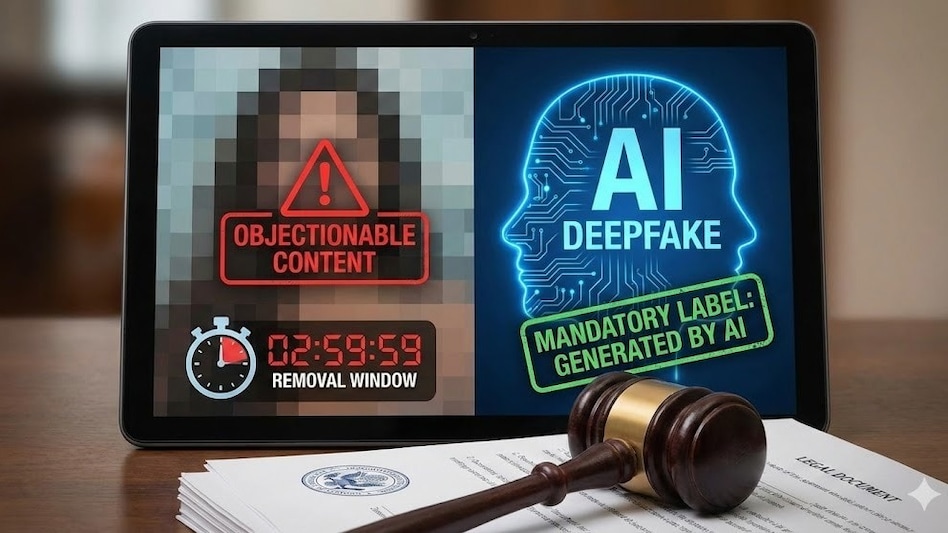
Govt tightens rules on AI-generated content, mandates labels and faster takedowns
In a significant move to enhance online safety, the Indian government has introduced stricter regulations concerning AI-generated and deepfake content. This new framework mandates clear labeling, permanent metadata, and expedited takedown procedures for online platforms. The Ministry of Electronics and Information Technology (MeitY) announced these changes on February 10, 2026, following the notification of the Information Technology (Intermediary Guidelines and Digital Media Ethics Code) Amendment Rules. Set to take effect on February 20, 2026, the revised rules explicitly define 'synthetically generated information' as audio, visual, or audio-visual content that is created or modified through computer resources to appear authentic. The guidelines clarify that basic editing or formatting, as well as the legitimate creation of educational materials, will not fall under this classification. To comply with the new regulations, platforms that facilitate the creation or distribution of AI-generated content must clearly label such information, ensuring it is easily identifiable as synthetic. Additionally, they are required to incorporate permanent metadata that includes unique identifiers, allowing for the tracking of the resources used in generating or altering the content. Importantly, intermediaries will not have the option to remove these labels or metadata. Social media platforms face new responsibilities as well. They must now prompt users to indicate whether their content is AI-generated prior to publishing and implement automated systems to verify these claims. If a platform is found to have knowingly hosted non-compliant content, it risks losing its legal protections due to failure in due diligence. The amendments also tighten the timelines for content removal and user grievance responses. Intermediaries are now required to act on lawful takedown requests within three hours, a significant reduction from the previous 36-hour window. User complaint resolutions will also see shortened response times, now set at seven days, with certain actions mandated within just two hours. Moreover, the new rules unequivocally prohibit AI-generated content that involves child sexual abuse, non-consensual images, and misleading representations of real individuals or events. Violations of these regulations can result in immediate content removal, account suspension, user identity disclosure to victims, and mandatory reporting to law enforcement authorities as per relevant laws.
Navigating the AI Landscape: Insights from a Former OpenAI Intern
As the demand for expertise in artificial intelligence surges, many are seeking ways to break into this dynamic field. H...
Business Insider | Jul 26, 2026, 10:10Market Turbulence: Four Key Factors Impacting Stocks This Week
This past week has been challenging for the stock market, driven by several significant forces that have created turbule...
CNBC | Jul 25, 2026, 20:05
Crisis Averted: Power Line Failure Highlights Urgent Need for Data Center Resilience
A power line failure near Washington, DC, recently showcased a significant challenge faced by the electrical grid due to...
TechCrunch | Jul 25, 2026, 13:50
Vision Breakthrough: US Startup Launches Groundbreaking Retina Chip in Europe
Science Corp is poised to introduce a revolutionary retina chip in Europe, designed to restore partial vision for indivi...
Business Today | Jul 25, 2026, 01:00
The Shift in Human Cognition: Embracing AI as a Collaborative Tool
As technology continues to evolve, a notable shift is occurring in the relationship between humans and artificial intell...
Business Insider | Jul 25, 2026, 09:50