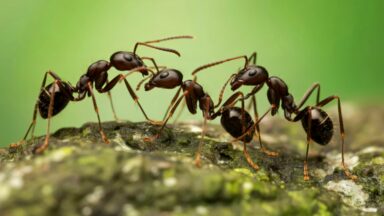
The evolution of expendability: Why some ants traded armor for numbers
The delicate balance between quality and quantity is a classic dilemma in economics, and it appears that this conflict extends to the realm of biology as well. A collaborative study by researchers from Britain, the United States, and Japan has uncovered how this trade-off influenced the evolutionary development of ants, one of the most successful groups of organisms on our planet. As ant colonies expanded in size and complexity, these insects made a surprising choice: rather than focusing solely on the strength of their individual workers, they opted for greater numbers and reduced armor. The cuticle, an essential exoskeleton that protects ants from threats such as predators and environmental hazards, plays a critical role in their survival. However, creating a durable cuticle demands significant resources, including nitrogen and rare minerals like zinc and manganese. While diminished armor can be detrimental to solitary insects, the evolution of ants has demonstrated a unique adaptation. According to Evan Economo, an entomologist at the University of Maryland and co-author of the study, this raises an intriguing question: "What happens to individual organisms as their societies become more complex?" He notes that as social structures develop, individual ants may simplify, relying on the collective strength of their colony to perform tasks that would typically require individual effort. The research team proposed that in social insects like ants, the metabolic investment in protective cuticles could lean towards collective survival rather than individual defense. The rationale is that a colony with thousands of workers can afford to lose a few to predation without jeopardizing its overall success. Therefore, allocating resources to fortify each worker's defenses could be viewed as an inefficient use of nutrients. To explore this hypothesis, the researchers conducted an extensive comparative study of ant anatomy. They utilized a global database known as Antscan, which features three-dimensional X-ray microtomography imaging of ant specimens from various regions around the world. This unprecedented approach allowed them to analyze the anatomical variations across ant species and lineages, shedding light on how these remarkable insects have adapted to their environments.
The High Stakes of Young Entrepreneurship: Balancing Ambition and Pressure
At just 19, Arlan Rakhmetzhanov embodies the relentless spirit of youth entrepreneurship. He believes there’s no in-betw...
TechCrunch | Jul 24, 2026, 17:40
Sam Altman's World Secures $52.5 Million in Crypto Funding for Online Verification
World, an innovative online verification platform co-founded by Sam Altman of OpenAI fame, has successfully raised $52.5...
TechCrunch | Jul 24, 2026, 16:40
Volkswagen Engineers Indicted for Insider Trading Linked to Rivian Partnership
In a significant legal development, the U.S. Department of Justice has brought securities fraud charges against two engi...
TechCrunch | Jul 24, 2026, 20:30
Cognition Acquires Poke: Redefining AI Interaction for Enhanced Productivity
Poke, the friendly AI assistant that users interact with as if chatting with a friend, is set to embark on a new journey...
TechCrunch | Jul 24, 2026, 18:25
Anduril's Valuation Set to Soar: A $100 Billion Funding Round on the Horizon
Anduril, a prominent player in defense technology, is reportedly gearing up for a significant funding round that could e...
TechCrunch | Jul 24, 2026, 17:40