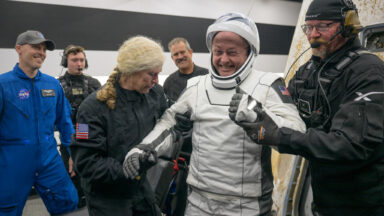
NASA’s first-ever medical evacuation from space ends with on-target splashdown
In a remarkable turn of events, a multinational crew consisting of two Americans, a Japanese astronaut, and a Russian cosmonaut has safely returned to Earth after spending 167 days in orbit. Their journey back was expedited due to a medical issue affecting one of the crew members, leading to an early departure from the International Space Station (ISS). The crew's splashdown occurred precisely in the Pacific Ocean near San Diego at 3:41 AM EST (08:41 UTC) aboard a SpaceX Crew Dragon spacecraft. The capsule made its descent through the atmosphere, leaving a trail of fiery brilliance visible from San Francisco to Los Angeles. As the spacecraft approached the water, four parachutes deployed, ensuring a controlled descent. NASA’s Crew-11 mission commander, Zena Cardman, expressed her relief and gratitude to the teams involved as she communicated with SpaceX mission control shortly after the landing. "It feels good to be home, with deep gratitude to the teams who got us there and back," she stated. Alongside her were NASA astronaut Mike Fincke, Japanese mission specialist Kimiya Yui, and Russian cosmonaut Oleg Platonov. The decision to return early was made after NASA detected a medical concern with one of the astronauts last week. Although details about the specific health issue remain undisclosed, officials clarified that it was not an emergency situation. The crew member was reported to be stable while still aboard the ISS, which allowed for a planned return rather than an immediate evacuation. Upon exiting the Dragon spacecraft, all astronauts appeared to be in good health and high spirits as they were transferred onto a recovery vessel. Joel Montalbano, NASA’s deputy associate administrator for space operations, mentioned that the astronauts would first visit a medical facility in San Diego before ultimately heading back to their home base at Johnson Space Center in Houston. This successful return marks a significant chapter in space exploration and underscores the importance of health monitoring during extended missions.
The Rise of AI Distillation: A Controversial Technique Sparks Debate in Tech and Government
In recent discussions, a once-obscure topic in artificial intelligence has surged to the forefront of debates among tech...
CNBC | Jul 25, 2026, 12:15
Unlocking the Secrets of Quantum Gravity: Can AI Help Physics Make a Leap?
The realm of scientific research is undergoing a profound transformation, fueled by the rapid advancements in artificial...
Business Today | Jul 25, 2026, 24:30
AI Transformations Lead to Major Job Cuts at Tech Giants
Monday.com, the innovative work management platform based in Tel Aviv, has recently announced significant layoffs, attri...
TechCrunch | Jul 26, 2026, 01:45
OpenAI's Micro Keypad: A Novelty for Coders or Just a Confounding Gadget?
Last week, OpenAI made its debut in the hardware landscape with the launch of Micro, a stylish keypad designed to integr...
TechCrunch | Jul 25, 2026, 24:40
Market Turbulence: Four Key Factors Impacting Stocks This Week
This past week has been challenging for the stock market, driven by several significant forces that have created turbule...
CNBC | Jul 25, 2026, 20:05