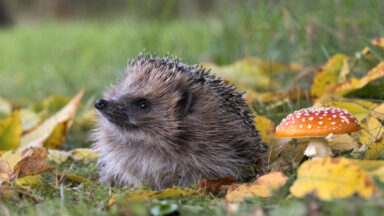
Can AI detect hedgehogs from space? Maybe if you find brambles first.
While pinpointing hedgehogs from outer space remains a challenge, researchers at the University of Cambridge are making strides in identifying their habitats by first locating bramble patches, their preferred shelters. This innovative research utilizes satellite imagery and artificial intelligence to map potential hedgehog habitats across the UK. The European hedgehog population has seen a dramatic decrease of approximately 30 to 50 percent over the past decade, complicating efforts to track these elusive nocturnal animals over vast landscapes. Rather than searching for the hedgehogs themselves, researcher Gabriel Mahler has developed an AI model capable of detecting brambles—thorny shrubs that provide both cover and foraging grounds for hedgehogs—using data from satellites. Brambles serve as crucial habitats for these small mammals, offering daytime shelter, nesting opportunities, and protection from predators. Additionally, these shrubs attract insects and produce berries, forming a vital food source for hedgehogs. Traditional methods for hedgehog surveys often involve extensive nighttime fieldwork, specialized equipment, or reliance on citizen scientists to report sightings—approaches that are not practical for large-scale conservation efforts. In contrast, satellite imagery allows for continuous monitoring over expansive areas. If AI can accurately identify essential habitat features like brambles, conservationists may gain a significant advantage in assessing habitats on a larger scale. Although AI has become a trendy term, it’s important to clarify that the detector developed by the Cambridge team does not rely on complex language models like ChatGPT. Instead, it employs straightforward machine learning techniques, including logistic regression and k-nearest neighbors classification. Mahler's bramble detector integrates TESSERA earth representation embeddings, which analyze imagery from the European Space Agency's Sentinel satellites, along with ground-truth observations gathered from iNaturalist, a citizen science platform. To validate the effectiveness of their model, Mahler and his colleagues—Sadiq Jaffer, Anil Madhavapeddy, and Shane Weisz—conducted a field test in Cambridge, utilizing smartphones and GPS devices to compare the model's predictions with real-life observations.
ServiceNow's CEO Highlights AI Safety Features Amidst Industry Concerns
Bill McDermott, the CEO of ServiceNow, asserted on Wednesday that the swift integration of artificial intelligence is bo...
CNBC | Jul 22, 2026, 23:05
Google's Cloud Surge Reflects Strong AI Investment Returns
Alphabet's recent earnings report offers a reassuring message to investors concerned about the company's substantial spe...
TechCrunch | Jul 22, 2026, 22:05
IBM Faces Setbacks Amidst AI Boom: Mainframe Business Struggles
IBM's recent earnings report revealed significant challenges for the tech giant, as it fell short of Wall Street's expec...
TechCrunch | Jul 22, 2026, 23:55
Gemini AI App Surges Towards One Billion Users, Challenging ChatGPT
Google's Gemini AI app is on the brink of a major milestone, boasting an impressive 950 million monthly active users as ...
Business Insider | Jul 22, 2026, 21:10Alphabet's Bold Commitment to AI Amidst Financial Challenges
Despite facing a challenging quarter, Alphabet is doubling down on its investments in artificial intelligence, signaling...
CNBC | Jul 23, 2026, 24:35