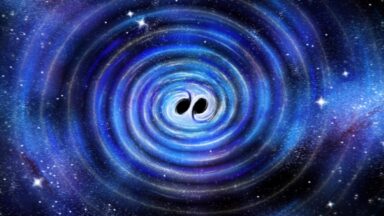
New black hole merger bolsters Hawking area theorem
In a remarkable validation of Stephen Hawking's theories, new research has provided compelling evidence supporting the physicist's prediction from 1971 regarding black holes. Hawking asserted that the total surface area of a black hole can only increase or remain constant, a principle known as the area theorem. According to a recent study published in Physical Review Letters, the gravitational signals captured from a black hole merger detected in January reinforce this concept. This significant finding coincides with the tenth anniversary of the LIGO collaboration's first detection of a black hole merger, a groundbreaking achievement that earned them the Nobel Prize. The study presents the most robust observational evidence to date in favor of Hawking's theorem. Additionally, a second paper has been submitted that proposes theoretical limits on a potential third tone that may exist in the gravitational wave signal from this event, although it has yet to be accepted. The LIGO/Virgo/KAGRA (LVK) collaboration is at the forefront of the quest to uncover gravitational waves produced by black hole and neutron star mergers. Through advanced laser interferometry techniques, LIGO measures minute changes in distance between two objects located kilometers apart, utilizing high-powered lasers. The LIGO facilities, located in Hanford, Washington, and Livingston, Louisiana, work in tandem with the Advanced Virgo detector in Italy, which became operational in 2016. KAGRA, Japan's first gravitational-wave detector, is notably built underground and began construction in 2021, with plans to be operational after 2025. Each detection instrument operates with extreme sensitivity, capable of registering minor ambient vibrations from sources such as freight trains or thermal movements in the detectors themselves. To ensure the accuracy of their data, the LIGO collaboration implements extensive measures to shield their instruments from noise. The landmark moment came on September 14, 2015, when both LIGO detectors recorded signals almost simultaneously, revealing the first direct evidence of black holes merging. This groundbreaking discovery earned the 2017 Nobel Prize in Physics, marking a significant milestone in the field of astrophysics.
Investment Insights: Avoiding Pitfalls in Startup Funding with Charles Hudson
Charles Hudson, a seasoned investor with over a decade of experience in early-stage startups, has witnessed significant ...
TechCrunch | Jul 09, 2026, 20:05
OpenAI's Fidji Simo Transitions to Part-Time Role Amid Health Challenges
Fidji Simo, the second-in-command at OpenAI, is stepping back from her full-time position, as reported by the Wall Stree...
TechCrunch | Jul 09, 2026, 23:50
Meta Unveils Muse Spark 1.1, A New Contender in AI Coding
On Thursday, Meta introduced Muse Spark 1.1, a sophisticated multimodal AI model designed specifically for coding tasks....
TechCrunch | Jul 09, 2026, 20:05
Jim Cramer Weighs In on SK Hynix’s Nasdaq Launch: Opportunities and Risks Ahead
On Thursday, Jim Cramer from CNBC highlighted that SK Hynix's imminent debut on the Nasdaq presents U.S. investors with ...
CNBC | Jul 09, 2026, 22:55
Slate Auto Partners with Crayola to Brighten Up EV Customization
Slate Auto, an electric vehicle startup with backing from Jeff Bezos, is redefining customization in the automotive worl...
TechCrunch | Jul 09, 2026, 19:30