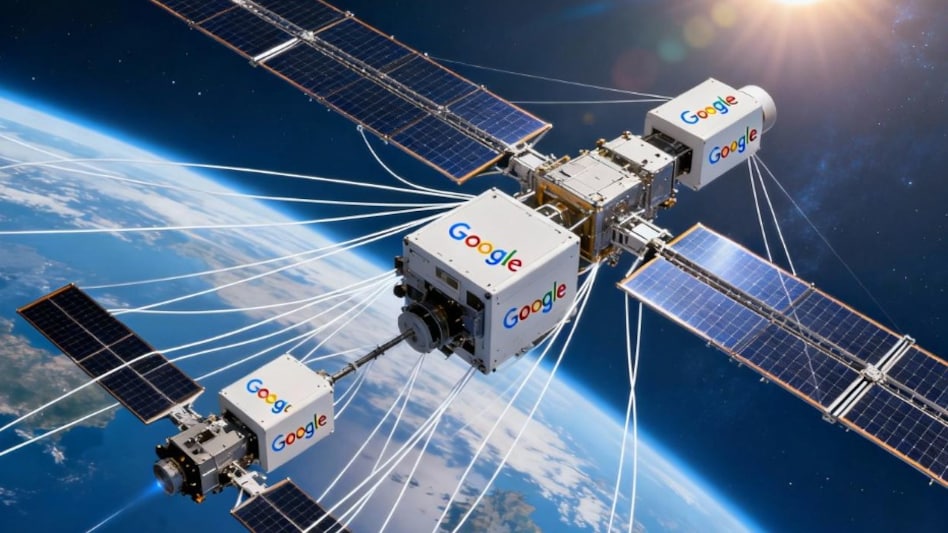
Google’s AI satellite sends first poem from space using onboard chip: Here’s how it worked
In a groundbreaking experiment, Google is testing the feasibility of constructing data centers in space to meet the increasing demands of artificial intelligence. The tech giant recently showcased its capability to run an AI model directly on a satellite in orbit, eliminating the need for ground-based computing. This innovative demonstration utilized one of Google’s Tensor Processing Units (TPUs) aboard a prototype satellite from Project Suncatcher. Upon receiving a command from Earth, the satellite processed the information in real-time and returned an AI-generated response. Initially, the task was to create a poem, marking the experiment as a crucial step in determining whether specialized AI hardware can function effectively in space. The outcomes of this experiment will significantly influence Google's future plans regarding orbital computing infrastructure. Developed in partnership with satellite company Planet, the prototype was launched using SpaceX's Falcon 9 rocket during the Transporter-18 rideshare mission. Before its launch, Google integrated its Gemma 4 AI model into the satellite. During its inaugural test, engineers prompted the satellite to generate a haiku from the perspective of a TPU in orbit. Google CEO Sundar Pichai hailed this achievement as a 'hello world' moment, akin to the first basic operation performed on a new computing system. As the satellite passed over Svalbard, Norway, the team successfully received the AI-generated poem, which read: Blue marble below Data streams in silent grace Starlight feeds my core. ✨ In addition to the poem, the satellite was also tasked with creating space-themed limericks and reporting on its technical status. The satellite is equipped with four TPUs, but its power is limited to 1 kilowatt, allowing it to operate only one chip at a time for roughly 20 minutes. These computing sessions must be carefully timed to coincide with the satellite's communication windows with ground stations. A significant concern remains whether the AI chips can endure the harsh conditions of space over extended periods. Cosmic radiation and solar activity pose threats that could alter stored data and computing results. Google conducted ground tests at UC Davis, exposing the Trillium TPUs to radiation levels equivalent to that experienced over a five-year space mission. The results indicated that AI inference might be less vulnerable to radiation than model training. Thermal management also presents a challenge, as the satellite lacks air to facilitate conventional cooling methods. Instead, it employs heat pipes and radiators for temperature regulation. Looking ahead, Google plans to launch two additional Suncatcher satellites in 2027, featuring enhanced power capacity and laser links to facilitate shared AI tasks. The company is optimistic about harnessing solar energy in orbit, which can generate up to eight times more power than on Earth. Nevertheless, the financial viability of orbital data centers remains uncertain. Experts estimate that SpaceX's Starship may need around 1,800 flights to make such facilities economically feasible by the 2030s. The upcoming months will be crucial in assessing the prototype's performance and determining the potential path for future satellite launches.
Amazon's $7.5 Billion Acquisition of Decart: A Strategic Move in the AI Chip Landscape
In a significant development for the tech industry, Amazon has announced its acquisition of Decart, a startup specializi...
TechCrunch | Nov 24, 2026, 15:55
Instagram Integrates AI Assistant Muse for Enhanced User Experience
In a significant move, Meta has announced the integration of its AI assistant, Muse, directly into Instagram's direct me...
TechCrunch | Nov 24, 2026, 17:25
Mathematicians React to Controversial Joke Over Lengthy Proof of Riemann Hypothesis
Tensions are rising in the mathematical community following a controversial comment made by Levent Alpöge, a researcher ...
Business Insider | Nov 24, 2026, 17:30Supertake Secures $20 Million to Revolutionize AI-Driven Investment Portfolios
Supertake, an innovative AI investing startup, is on a mission to transform how individuals engage with the stock market...
TechCrunch | Nov 23, 2026, 22:10
Figma Engineer Files Lawsuit Claiming Workplace Harassment and Retaliation
A former engineer at Figma has initiated legal action against the design software firm and its CEO, Dylan Field, citing ...
TechCrunch | Nov 23, 2026, 23:15