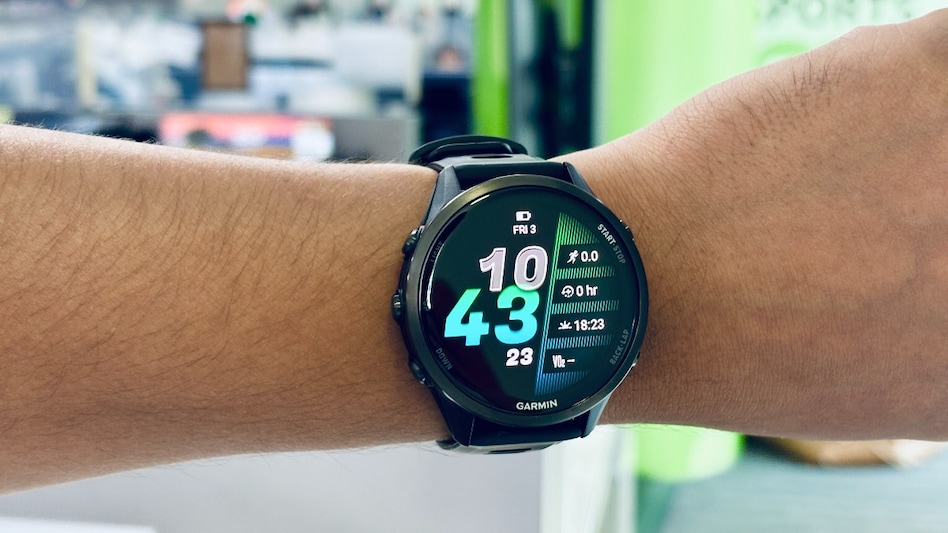
Garmin Forerunner 970 review: A supercomputer for runners, but not for everyone
Admittedly, I’m not a seasoned runner. My routine consists of the occasional 5K when I feel the urge to get moving. However, testing the Garmin Forerunner 970 over the past two weeks has been an enlightening experience. This device transcends the boundaries of a standard smartwatch; it serves as a meticulous coach for dedicated athletes, especially those who have a passion for running. Even as a casual jogger, I was drawn into its intricate world of data and impressive technology. On my first run with the Forerunner 970, I was taken aback by the wealth of information it provided. Unlike typical wearables that simply log pace, time, and distance, this smartwatch goes the extra mile. It monitors running power, cadence, stride length, ground contact time, vertical oscillation, and even step speed loss. When paired with Garmin’s HRM strap, it offers advanced metrics such as running economy and tolerance. Initially, the sheer volume of data felt overwhelming, but I quickly learned to identify trends. My stride efficiency was commendable, though my cadence dropped midway through the run, and I noticed I was spending too much time on the ground. This transformed running from a mere physical activity into a science of self-improvement. Surprisingly, the Forerunner 970 is lightweight despite its robust design featuring sapphire glass, a titanium bezel, and a substantial AMOLED screen. I wore it throughout the day and even to bed, only removing it during showers, although it’s water-resistant enough to withstand that, too. The strap did feel a bit uncomfortable at first, but I adjusted to it within days, making it feel like a natural extension of my wrist. One standout feature was the sleep tracking capability. I used the Forerunner 970 alongside an Apple Watch for comparison, and I found Garmin’s data to be more reliable and consistent. It provided detailed breakdowns of my sleep stages—light, deep, REM, and wakefulness—even identifying interruptions I hadn’t noticed. The insights gave me a clearer understanding of my sleep quality, unlike the Apple Watch which sometimes felt less reliable. Battery life is another area where the Forerunner 970 truly excels. After charging it fully upon unboxing, I’ve only had to recharge it once over the last two weeks, even with continuous GPS tracking and health monitoring. This kind of endurance is hard to find in other smartwatches, which often require nightly charging. The freedom from constant charging is a luxurious experience. The AMOLED display is exceptional as well, providing vibrant colors and clarity even in bright sunlight, making it easy to read health metrics. Garmin offers an extensive range of data, including heart rate, blood oxygen levels, stress levels, and VO₂ max, all displayed clearly on the large screen. Primarily, the Forerunner 970 is a runner’s watch, and it excels in that domain. Its multi-band GPS is impressively accurate, even outperforming the Apple Watch in urban settings. It includes full-color maps and turn-by-turn navigation, features I initially thought I wouldn’t use but found quite useful. Additionally, the built-in LED torch is a handy addition for nighttime activities. However, the Forerunner 970 is not exclusively for runners. It supports various activities, including cycling, swimming, hiking, and even yoga, tracking metrics relevant to each sport. I logged some strength training sessions and was impressed by its ability to accurately count reps and sets. Cyclists can also benefit from detailed power and cadence information when paired with compatible sensors. Although Garmin has focused on fitness, it hasn’t neglected smartwatch essentials. While it may not compete with Apple or Samsung in terms of app variety, it balances fitness tracking with enough smart features to be functional. That said, it’s not without flaws. The battery life takes a hit with the always-on display feature, limiting usage to about 4-5 days compared to the two-week run I experienced with it off. Additionally, the user interface can be somewhat clunky, with dense menus and occasional ghost touches, reminding users that this watch is primarily designed for athletes. Pricing is another consideration. At approximately ₹90,990 in India, this device sits at the high end of the market. It’s a remarkable piece of technology, providing extensive insights into training and health, making it an ideal choice for serious athletes. However, for those like me who run casually, it may be more than what’s necessary. A more budget-friendly Garmin model or a fitness-oriented smartwatch might suffice. After two weeks with the Forerunner 970, I gained a new perspective on running as a science rather than just exercise. While I may not be ready to fully embrace that lifestyle, I understand why serious athletes regard Garmin with such respect.
AegisAI Secures $36 Million to Combat AI-Powered Phishing Threats
In an era where cyber criminals are increasingly leveraging artificial intelligence to execute sophisticated attacks, em...
TechCrunch | Jul 23, 2026, 18:45
Meta and Anthropic's Ad Strategies: A Tale of Optimism vs. Pessimism in AI Marketing
In a vivid contrast of advertising approaches, Meta and Anthropic have recently launched AI campaigns that reflect their...
Business Insider | Jul 23, 2026, 17:05Anthropic Enhances Claude's Voice Capabilities with New Models
In a strategic response to recent developments in the AI landscape, Anthropic has announced an update to its Claude voic...
TechCrunch | Jul 23, 2026, 19:35
Tesla's Robotaxi Ambitions Hit a Bump as Mileage Declines
Tesla's much-anticipated Robotaxi network has experienced a surprising downturn, driving fewer miles for paying customer...
TechCrunch | Jul 23, 2026, 17:10
Meta Exits Renewable Energy Initiative Amid Surge in Natural Gas Projects
In a significant shift, Meta has announced its departure from the RE100 initiative, a prominent corporate renewable ener...
TechCrunch | Jul 23, 2026, 20:05