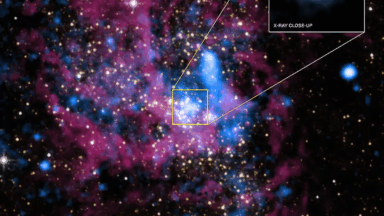
There may be “dark main sequence” stars at the galactic center
The mass of a star is a pivotal factor in determining its life cycle and the rate at which it consumes hydrogen. Scientists have established a 'main sequence' akin to a periodic table for stars, linking their mass and age to various characteristics. This framework relies on the widely accepted premise that energy comes from the gravitational fusion of lighter elements into heavier ones. However, a team of three astrophysicists is exploring a groundbreaking alternative source of energy that could be prevalent at the core of our galaxy. They propose that energy could also arise from the collisions and annihilations of dark matter particles and their antiparticles. While the nature of dark matter remains a mystery, this hypothesis opens up intriguing possibilities, such as the existence of seemingly immortal stars and others that might regress along the main sequence. Current theories suggest that dark matter likely consists of elementary particles, which, similar to known particles, should have antimatter counterparts. When these particles collide, they would annihilate each other, releasing energy. However, such interactions are rare due to dark matter's elusive nature, primarily occurring in regions with high concentrations of dark matter. The center of our galaxy is the most plausible location for these high-density collisions. Previously, an excess of radiation detected from the galactic core led scientists to speculate about dark matter annihilations, although further investigation revealed a more conventional explanation. Close to the supermassive black hole at our galaxy's center, the extreme conditions could allow dark matter interactions to become significant, potentially offering more energy to stars in orbit than traditional fusion processes. These findings could reshape our understanding of star formation and evolution, particularly in environments dominated by dark matter. Astronomers continue to investigate the implications of such energy sources on stars in these unique galactic settings.
2025: A Pivotal Year in the AI Landscape
The AI sector experienced remarkable shifts in 2025, marked by significant investments and fierce competition among tech...
Business Insider | Dec 27, 2025, 10:20FaZe Clan Faces Turbulent Times as Influencers Exit Amid Contract Disputes
In a significant shakeup for the esports organization FaZe Clan, six prominent influencers have announced their departur...
TechCrunch | Dec 27, 2025, 20:55
Silicon Valley's AI Landscape Shaken by New Deal Dynamics
In a surprising move that sent ripples through the tech community, Nvidia announced a non-exclusive licensing agreement ...
Business Insider | Dec 27, 2025, 10:00Elevate Your LinkedIn Presence: Innovative AI Prompts for a Standout Profile
The landscape of professional networking is rapidly evolving, and artificial intelligence is playing a pivotal role in h...
Mint | Dec 27, 2025, 10:00
Motorola's Premium 'Signature' Series Set to Launch in India: What to Anticipate
Motorola has officially announced the impending launch of its 'Signature' series in India, igniting excitement among tec...
Mint | Dec 27, 2025, 11:30