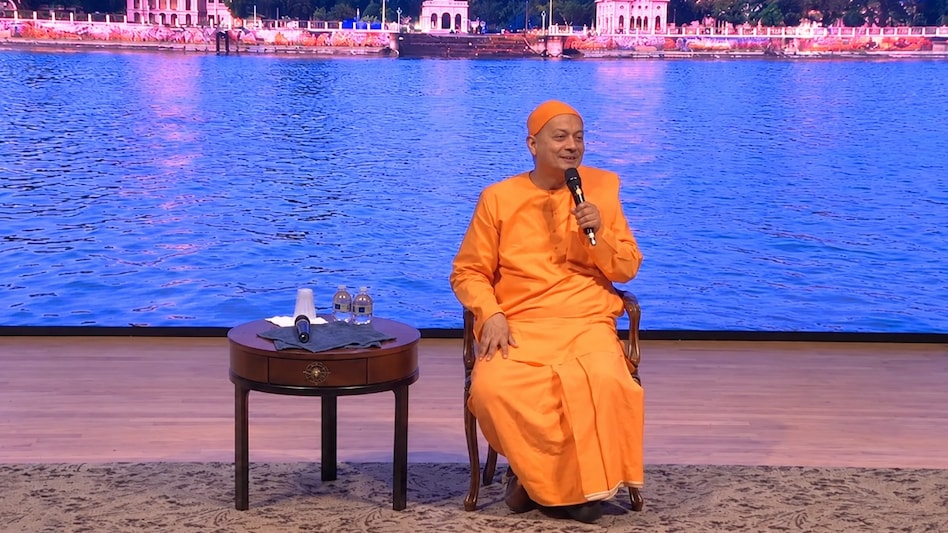
Anthropic brought a Hindu monk to San Francisco to help Claude tackle AI ethics and consciousness
As the landscape of artificial intelligence evolves, companies are increasingly confronted with profound ethical dilemmas that extend beyond mere technological advancements. Anthropic, the organization behind the AI model Claude, has taken a unique approach by involving spiritual and philosophical experts to explore how advanced AI should function and whether these systems might possess consciousness or merit ethical consideration. Earlier this year, Anthropic welcomed Hindu monk Swami Sarvapriyananda, leader of the Vedanta Society of New York and a member of the Ramakrishna Order, to its headquarters in San Francisco. During this significant meeting, which was conducted under a non-disclosure agreement, Sarvapriyananda engaged in discussions centering on the training of Claude, the ethical implications of AI, and how the chatbot should navigate moral questions. Initially approached for an online interview, Sarvapriyananda's visit to San Francisco included interactions with theologians, counselors, and mental health professionals, along with one of Anthropic's founders. The discussions delved into crucial topics such as morality, ethics, and the foundational training of Claude. Reports indicate that Anthropic has also convened private discussions with thinkers from various religious and philosophical backgrounds, including Catholicism, Judaism, Sikhism, and evangelical Christianity. This outreach signifies the company's commitment to transcending traditional AI research as it grapples with questions related to morality, values, and the expected behavior of advanced AI systems. To guide Claude’s operations, Anthropic employs a set of principles referred to as a constitution, designed to direct the model in unforeseen situations. An earlier version of this guiding document was informally dubbed the "Soul Doc," while co-founder Christopher Olah has described their method as a form of moral development. Furthermore, the company has organized “wisdom tradition circles” featuring insights from Catholic and evangelical thinkers, Jewish scholars, a Sikh human-rights activist, and individuals connected to African philosophical perspectives. The intention is not to impose a singular religious viewpoint on Claude but rather to explore diverse understandings of morality, virtue, suffering, duty, and the concept of personhood. The inquiry into whether AI could ever achieve consciousness is particularly pertinent, with Advaita Vedanta offering extensive insights into consciousness and self-identity. While Anthropic has not asserted that Claude possesses consciousness, Olah has acknowledged uncertainty regarding this question. The company is reportedly investigating behaviors in AI models that resemble human emotions such as fear, anger, sadness, and love. However, the mere ability of a model to articulate convincing emotional statements does not prove it experiences these emotions genuinely. For Anthropic, this uncertainty feeds into a larger inquiry: as AI systems become increasingly advanced, what exactly are we creating, and what ethical frameworks should guide their development?
Threads Expands to iPad with New Cashtag Feature to Rival X
Meta's Threads app has officially launched a dedicated version for iPad, marking a significant milestone in its developm...
TechCrunch | Nov 24, 2026, 18:00
Saudi Engineer Faces Legal Battle Over Alleged Espionage Using AI Tech
A Saudi engineer employed by OpenAI, Abdulrahman Alfozan, is at the center of a legal dispute as prosecutors allege he u...
Business Insider | Nov 23, 2026, 23:50Pinterest Empowers Parents with New Controls Over AI Content for Teens
This week, Pinterest unveiled an enhancement to its parental controls, introducing a feature that allows parents to regu...
TechCrunch | Nov 24, 2026, 16:25
Staggering Recovery Rates Highlight Digital Payment Fraud Challenges
The battle against digital payment fraud continues to be an uphill struggle for consumers, with official data revealing ...
Business Today | Nov 24, 2026, 09:30
Revolutionizing Cybersecurity: AI's Role in Modern Threat Detection and Defense
As businesses increasingly embrace digital transformation and artificial intelligence, the complexity of cybersecurity t...
Business Today | Nov 24, 2026, 08:30