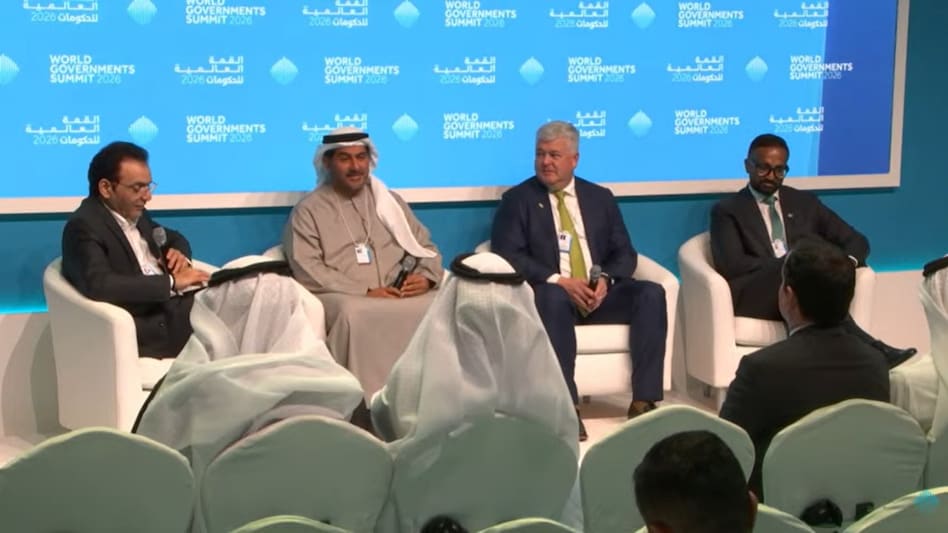
World Governments Summit 2026: From UPI to AI agents - How tech leaders see future of digital living
In a world where digital lifestyles have become the norm, what once seemed as far-fetched as space exploration is now an integral part of daily life. The World Governments Summit 2026 in Dubai highlighted this transformation, focusing on how technology is reshaping our experiences as much as it is our infrastructure. During the session titled “Design Digital Lifestyles: From Infrastructure to Experience,” industry pioneers from telecommunications, fintech, and artificial intelligence gathered to sketch the future of digital living on a global scale. Khalifa Alshamsi, CEO of e& International and e& Life, opened the conversation by emphasizing that telecom companies have evolved beyond mere data carriers. He reminisced about how e& has transitioned in just three years from a traditional telecom operator to a comprehensive technology powerhouse, investing in platforms that enhance consumer and government services alike. Alshamsi pointed to successful models like India’s Unified Payments Interface (UPI) and Brazil’s PIX, noting how these innovations have established global benchmarks for digital finance. He stated, "India’s UPI is a global reference point, showcasing how a country with limited banking access can evolve into a digitally connected financial ecosystem, drastically cutting transaction costs." While telecom companies are broadening their horizons, fintech has faced challenges, often battling regulatory hurdles. Daniel Gallagher, Chief Legal, Compliance and Corporate Affairs Officer at Robinhood, shared insights on how the app-first design of their platform has revolutionized investing, often in spite of regulatory constraints. He explained that Robinhood was built to operate as a mobile-native brokerage, rather than just a digital version of a traditional firm. Artificial intelligence is now taking center stage in transforming user interfaces and experiences. Ashish Koshy, CEO of Inception, the AI division of G42, pointed out that digital interactions are moving beyond conventional menus and clicks. "The future is intent-driven," he stated, emphasizing the expectation for AI agents to execute user commands seamlessly. However, he warned that readiness for AI goes beyond user experience; it encompasses issues like sovereignty and the integration of private and public sector innovations. A key discussion point was how emerging markets can circumvent the challenges faced by developed economies. Alshamsi advocated for the importance of designing inclusive systems from the outset. He stressed that true inclusion must be prioritized to ensure that all segments of society, including blue-collar workers, can benefit and build wealth from the economies they contribute to. Looking forward, the panel shared a consensus on the trajectory of digital lifestyles. Alshamsi predicted that ease of use and personalization will drive rapid adoption of new technologies. Gallagher imagined a future where financial services are unified onto a single platform, with everything tokenized and AI-assisted around the clock. Koshy affirmed that the future interface will not be an app, but rather an intelligent agent that will fulfill user intentions across multiple services, ensuring streamlined outcomes.
Staggering Recovery Rates Highlight Digital Payment Fraud Challenges
The battle against digital payment fraud continues to be an uphill struggle for consumers, with official data revealing ...
Business Today | Nov 24, 2026, 09:30
Investing in the Future: Solar and Battery Solutions for AI Data Centers
The challenge of powering AI data centers has emerged as a pivotal issue in the current technological landscape. Over th...
TechCrunch | Nov 24, 2026, 16:25
realme P4x 5G vs vivo Y31t 5G: Which Smartphone Offers the Best Bang for Your Buck?
When it comes to choosing between the realme P4x 5G and the vivo Y31t 5G, potential buyers are faced with distinct advan...
Business Today | Nov 24, 2026, 01:50
Mathematicians React to Controversial Joke Over Lengthy Proof of Riemann Hypothesis
Tensions are rising in the mathematical community following a controversial comment made by Levent Alpöge, a researcher ...
Business Insider | Nov 24, 2026, 17:30Emerging AI Chip Design Revolution: A Challenge to Nvidia's Reign
Nvidia, under the leadership of Jensen Huang, faces a significant challenge from the very AI technology it helped to pop...
Business Insider | Nov 24, 2026, 10:10