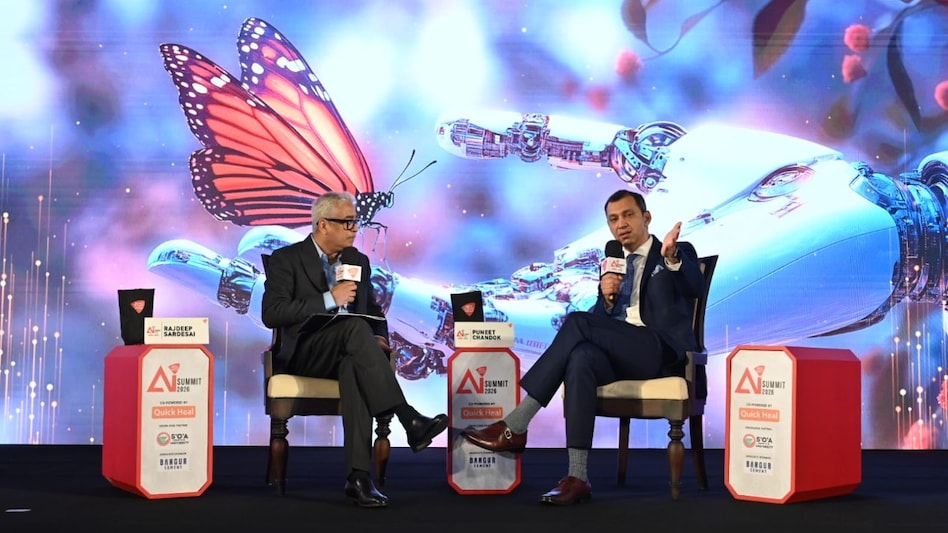
'AI won't replace you, someone who knows AI will': Microsoft India chief on job loss fears
Puneet Chandok, President of Microsoft India and South Asia, recently addressed the future of employment in the wake of advancing artificial intelligence. He emphasized that while AI itself will not cause job losses, individuals who do not adapt to using AI tools could find themselves outpaced by those who do. "My biggest concern isn't about jobs disappearing; it's about our ability to progress in India," Chandok stated during the India Today AI Summit. With an ambitious goal of scaling AI proficiency to 20 million people in the coming years, he stressed the need for further efforts to uplift a billion Indians through AI. Chandok pointed out the necessity for professionals to become adept at utilizing AI technologies. "It's not AI that will take jobs; it's the individuals who master AI who will gain the upper hand," he cautioned. This highlights the urgency for workforce adaptation in an AI-driven landscape. In his session titled Life, Work, Home: Atmanirbhar AI, Chandok elaborated on the concept of self-reliant AI for India. He described Atmanirbhar AI as the development and utilization of AI systems tailored specifically to meet India’s unique economic and social challenges. He noted that India is transitioning from being merely a consumer of global AI technologies to becoming a significant contributor and exporter of innovative AI solutions. Chandok defined technological independence not as detaching from global ecosystems but as cultivating strong domestic capabilities built upon global platforms, ensuring that innovations align with national interests. "Atmanirbhar AI aims to empower individuals, organizations, and government entities across India to leverage AI for greater achievements," he stated. He also highlighted the transformative impact of AI on various sectors, illustrating how AI tools are improving educational outcomes for students, expediting disease diagnosis for healthcare professionals, and enabling entrepreneurs and MSMEs to scale up their businesses effectively. Chandok emphasized that AI applications in India must tackle pressing challenges such as enhancing healthcare access, boosting agricultural productivity, and fostering financial inclusion. Chandok expressed optimism about India's potential to emerge as a leader in the global AI landscape, citing the country's extensive talent pool, vibrant market, and strong digital infrastructure. He pointed to India's achievements in large-scale digital initiatives like identity verification and payment systems as evidence of its capability to implement technology effectively. The next phase, he argued, involves integrating AI into these platforms and creating AI models that resonate with India's diverse linguistic and cultural landscape.
Waymo Considers Parting Ways with Uber Amid Rising Tensions
Waymo is reportedly exploring options to exit its partnership with Uber, which has allowed the Alphabet-owned firm to de...
TechCrunch | Jul 24, 2026, 21:00
OpenAI's Micro Keypad: A Novelty for Coders or Just a Confounding Gadget?
Last week, OpenAI made its debut in the hardware landscape with the launch of Micro, a stylish keypad designed to integr...
TechCrunch | Jul 25, 2026, 24:40
The Rise of AI Distillation: A Controversial Technique Sparks Debate in Tech and Government
In recent discussions, a once-obscure topic in artificial intelligence has surged to the forefront of debates among tech...
CNBC | Jul 25, 2026, 12:15
Shifting Focus: The Cost-Effectiveness of AI Models Takes Center Stage
In recent years, the AI sector has been intensely focused on identifying the most advanced models. While this pursuit re...
Business Insider | Jul 25, 2026, 13:10The Aluminum Foil Trend: A DIY Shield Against Wireless Identity Theft
Have you noticed an unusual trend where people are wrapping their wallets in aluminum foil? This peculiar practice has e...
Business Today | Jul 25, 2026, 02:45