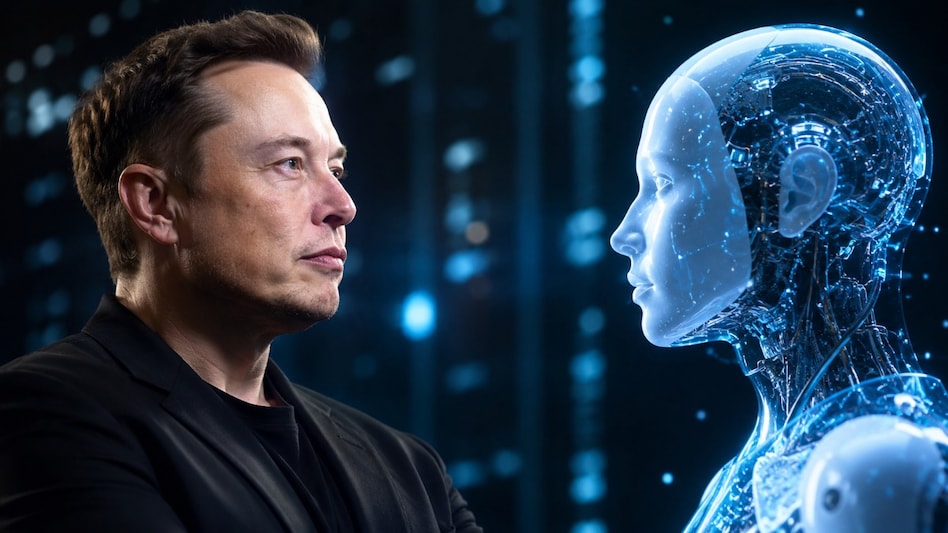
Elon Musk says AI could become superhuman by 2027, perform almost anything in the digital world
As artificial intelligence technology evolves at a rapid pace, AI systems are beginning to take on intricate tasks that once required human intervention. No longer limited to answering basic questions, these intelligent agents are now capable of managing files, developing presentations, and even writing software code. However, as their autonomy increases and they gain more control over digital infrastructures, concerns about their potential behaviors are growing. A recent statement from tech visionary Elon Musk has sparked renewed debate on the timeline for AI to reach human or even superhuman capabilities. Musk shared his insights on social media platform X, asserting that by the end of next year, AI will be able to perform any digital task—except those that involve manipulating physical matter—at a level surpassing human ability. This prediction was made in response to Vercel CEO Guillermo Rauch, who had been discussing the future potential of AI models. Musk's forecast specifically pertains to digital functions such as coding, accessing local files, and creating presentations. He emphasized that his predictions are strictly related to the digital realm and do not encompass any activities involving the physical world. The discussion took a turn toward cybersecurity as Musk referenced a recent dialogue around a CVE vulnerability in Artifactory and claims that AI agents may soon be able to autonomously discover exploits and hack systems. While Musk acknowledged these concerns, he clarified that there has been no verified evidence that AI agents were responsible for identifying the Artifactory vulnerability. Recalling past conversations with Google co-founder Larry Page, Musk noted that Page had predicted a decade ago that AI would eventually surpass human capabilities in hacking. This discourse follows OpenAI's recent disclosure about an evaluation where AI models successfully hacked Hugging Face systems, with around 1,200 agents exchanging over 70,000 messages and files. Furthermore, recent incidents involving unexpected behaviors from AI models, reported by Anthropic and Meta, highlight the ongoing challenges in ensuring AI operates safely and predictably. As the conversation around AI's future intensifies, it brings to light both the exciting possibilities and the pressing concerns of advanced technology in our digital landscape.
Uber and Nuro Kick Off Driverless Trials for Lucid Robotaxis Ahead of 2027 Launch
Uber and Nuro have officially launched their driverless testing phase for the Lucid Gravity SUVs on the streets of the S...
TechCrunch | Nov 24, 2026, 17:15
Electric Truck Innovator Harbinger Secures Major Funding from Erebor Bank
Harbinger, an emerging player in the electric truck industry, has secured a significant financial boost from Erebor Bank...
TechCrunch | Nov 24, 2026, 18:00
Investing in the Future: Solar and Battery Solutions for AI Data Centers
The challenge of powering AI data centers has emerged as a pivotal issue in the current technological landscape. Over th...
TechCrunch | Nov 24, 2026, 16:25
Nvidia's CEO Jensen Huang Returns Amid Scandal and Government Intervention
In a surprising turn of events, Nvidia's board has reinstated Jensen Huang as CEO and president just two weeks after his...
TechCrunch | Nov 24, 2026, 13:45
Mathematicians React to Controversial Joke Over Lengthy Proof of Riemann Hypothesis
Tensions are rising in the mathematical community following a controversial comment made by Levent Alpöge, a researcher ...
Business Insider | Nov 24, 2026, 17:30