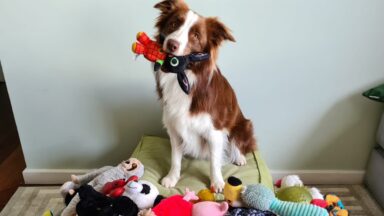
Some dogs can classify their toys by function
Recent research has uncovered that some dogs possess the remarkable ability to categorize their toys based on function, not just name recognition. Published in the journal Current Biology, the study reveals that these canines can extend their understanding of labels to new objects that serve similar purposes, even if their appearances differ. This advanced cognitive skill, referred to as "label extension," typically requires extensive training in a controlled environment. However, the dogs involved in this study showcased this ability spontaneously through natural play with their owners, without any formal instruction. Claudia Fugazza, a co-author from Eötvös Loránd University in Budapest, Hungary, likened this phenomenon to a person equating a hammer and a rock, or a child recognizing that the term "cup" can apply to various drinking vessels like mugs or glasses. The research team, which has focused on canine cognition for several years, previously explored how dogs interpret human gestures. Their findings indicated that dogs respond to pointing as a directional cue, unlike human toddlers who tend to concentrate more on the object itself. This behavior, termed spatial bias, is influenced by a dog's visual acuity and cognitive capabilities. Notably, smarter dog breeds were found to balance the object's appearance with its location more effectively. Additionally, the study examined the correlation between a dog's head length and visual acuity, revealing that shorter-headed dogs tend to have vision more similar to humans. This is due to a higher density of retinal ganglion cells in their central vision, enhancing clarity and depth perception. The results indicated that dogs with superior visual acuity and cognitive test scores displayed reduced spatial bias, suggesting that cognitive processing plays a significant role in how dogs perceive their surroundings. Ultimately, this research highlights the complex cognitive abilities of dogs, indicating that intelligence may influence their spatial awareness as much as their sensory perceptions.
Canada's Cyber Sleuths: Unveiling Operations Against Drug Traffickers and Cybercriminals
In a rare disclosure, Canada's Communications Security Establishment (CSE) has revealed its engagement in a series of st...
TechCrunch | Jul 06, 2026, 15:05
The Wave of AI-Driven Layoffs: Major Tech Companies Restructure Amidst Job Cuts
In a significant shift within the tech industry, Microsoft announced a reduction of approximately 4,800 jobs, representi...
TechCrunch | Jul 06, 2026, 19:40
Emerging AI Threat: The Rise of Agentic Ransomware Unveiled
Researchers from Sysdig, a cybersecurity firm, have uncovered a significant development in the realm of cyber threats. T...
Business Insider | Jul 06, 2026, 17:00Small Businesses Embrace AI: A Double-Edged Sword
Small businesses are increasingly looking to artificial intelligence as a means to innovate and streamline their operati...
Business Insider | Jul 06, 2026, 14:00Kentucky Welcomes Major AI Data Center to Fuel Anthropic's Ambitions
In a significant development for the tech landscape, Kentucky is poised to unveil a large-scale artificial intelligence ...
Business Insider | Jul 06, 2026, 15:05