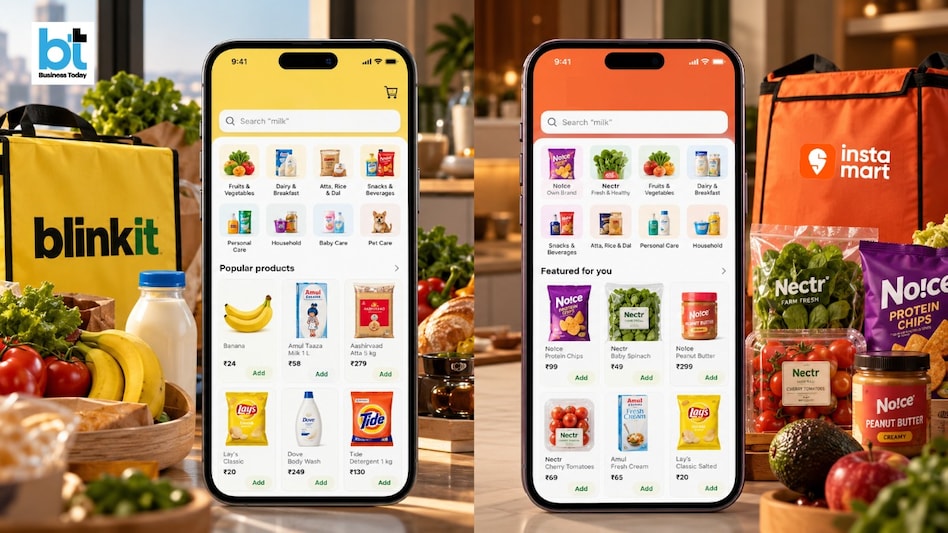
BT BIG STORY | Private-label divide: Why Blinkit and Instamart are placing opposite bets
As the quick-commerce sector seeks sustainable growth beyond mere delivery speed and discounts, Blinkit and Swiggy's Instamart are adopting fundamentally different strategies regarding private labels. This contrast became particularly evident following the recent earnings reports from both companies, highlighting varying perspectives on the role of private branding in enhancing margins and customer loyalty. Blinkit's CEO, Albinder Dhindsa, has expressed skepticism about the private label model, asserting that such brands must either create additional demand or enhance the economics of existing sales after factoring in the associated development and marketing costs. In his view, merely attaching a brand name to a product does not suffice. To succeed, a private label requires significant investments in product development, quality assurance, inventory management, and marketing—all areas where established brands typically excel. Moreover, Blinkit has voiced concerns that promoting private labels could lead to conflicts with third-party sellers on its platform. Instead, the company is focusing on enhancing supply chain control, particularly in fruits and vegetables through its Hyperpure initiative, without the need to establish a separate consumer-facing brand. Conversely, Swiggy's Instamart is embracing private labels as a core element of its differentiation strategy. The company argues that offering a carefully curated assortment can set it apart in a market where rapid delivery and competitive pricing are rapidly becoming standard. Instamart's Switch initiative combines its own brands, such as No!ce and Nectr, with collaborations from around 400 other brands, aiming to provide superior options across key categories. Recent results indicate that products from the Switch initiative accounted for over 20% of orders on the platform, with the clean food brand No!ce achieving remarkable retention rates among customers. Industry experts like Shobit Singhal from Anand Rathi Institutional Equities note that Blinkit's strategy reflects potential conflicts inherent in operating a marketplace while simultaneously competing with brands on that platform. By focusing on established partnerships, Blinkit can generate advertising revenue without the complexities of building consumer brands. In a discussion with Business Today, Apoorve Goyal from Prosus highlighted that private labels allow quick-commerce platforms to exert more control over pricing and customer relationships while potentially boosting repeat purchases. However, as noted by analysts, the economic dynamics differ for retailers compared to traditional FMCG companies. Deloitte's Anand Ramanathan pointed out that while private labels present a clear advantage for retailers in terms of margins, the same cannot be said for FMCG firms that already enjoy substantial profit margins, as the costs associated with launching new products can erode profitability. Swiggy's challenge to prove a path to profitability through private labels is acknowledged by experts like Ashwini Mehta from Ambit Capital, who warns that building and scaling brands requires capabilities that may alienate existing brand partners crucial for advertising revenue. In light of these diverging approaches, the quick-commerce industry faces a pivotal question: can private labels generate enough margin and customer loyalty to validate the investment in brand development, or will platforms be better off focusing on distributing established brands while monetizing their visibility and discovery features? The outcome of this strategic divergence may well shape the future of quick commerce.
Navigating the AI Landscape: Why CEOs Must Embrace Technology Literacy
In the rapidly evolving world of corporate India, companies are increasingly investing in artificial intelligence (AI), ...
Business Today | Nov 24, 2026, 07:35
realme P4x 5G vs vivo Y31t 5G: Which Smartphone Offers the Best Bang for Your Buck?
When it comes to choosing between the realme P4x 5G and the vivo Y31t 5G, potential buyers are faced with distinct advan...
Business Today | Nov 24, 2026, 01:50
Mathematicians React to Controversial Joke Over Lengthy Proof of Riemann Hypothesis
Tensions are rising in the mathematical community following a controversial comment made by Levent Alpöge, a researcher ...
Business Insider | Nov 24, 2026, 17:30Emerging AI Chip Design Revolution: A Challenge to Nvidia's Reign
Nvidia, under the leadership of Jensen Huang, faces a significant challenge from the very AI technology it helped to pop...
Business Insider | Nov 24, 2026, 10:10Uber and Nuro Kick Off Driverless Trials for Lucid Robotaxis Ahead of 2027 Launch
Uber and Nuro have officially launched their driverless testing phase for the Lucid Gravity SUVs on the streets of the S...
TechCrunch | Nov 24, 2026, 17:15