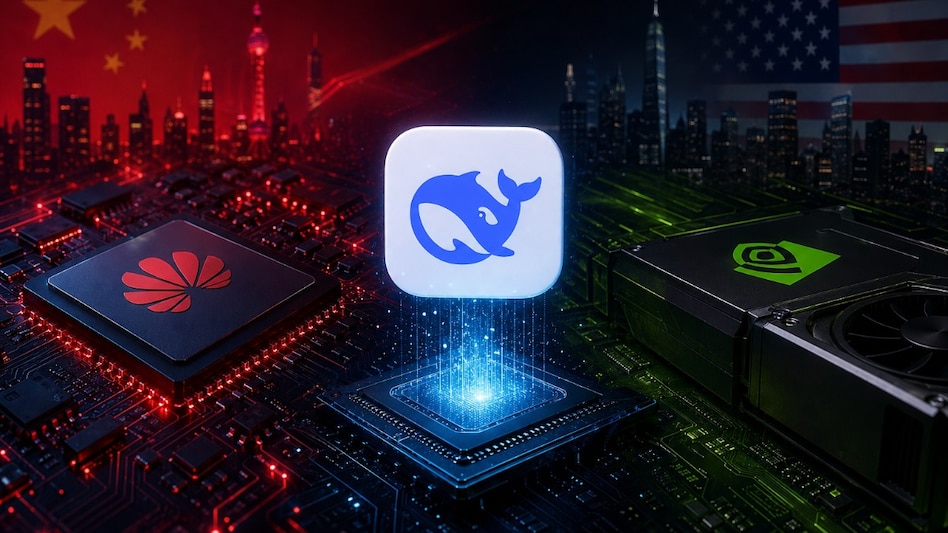
Can DeepSeek’s Huawei-powered V4 dent Nvidia’s $5 trillion dominance?
As Nvidia recently achieved a staggering $5 trillion market capitalization, Chinese startup DeepSeek has launched a groundbreaking series of large language models that may disrupt the chip titan's reign. The V4 model family was unveiled on the same day Nvidia hit this financial milestone, marking DeepSeek's most ambitious release since its R1 model caused significant tremors in the market back in early 2025, leading to a loss of nearly $600 billion in Nvidia's valuation. In a recent podcast discussion, Nvidia's CEO Jensen Huang voiced concerns over DeepSeek's new models, particularly if they are optimized for Huawei Technologies' chips. He warned that this shift could be detrimental to the United States, as it may allow China to outpace the US in AI technology if future models are based on a different tech framework. At the heart of DeepSeek's release is the V4-Pro, a 1.6 trillion-parameter model designed for intricate coding and task execution, accompanied by the more agile V4-Flash variant, which prioritizes speed and cost efficiency. Notably, this marks a pivotal moment for DeepSeek as it has chosen to optimize its flagship model for Huawei's domestic chips rather than Nvidia's GPUs, reflecting a significant move towards self-reliance in China's AI landscape. DeepSeek is once again aiming to shake up the market with its approach to cost. The V4-Pro model utilizes only 49 billion parameters per token, enabling it to achieve near-elite performance while maintaining significantly lower operational costs. The company claims that this allows for outputs comparable to leading models at a fraction of their price. For instance, V4-Pro's API pricing stands at $1.74 per million input tokens and $3.48 per million output tokens, which is about 50 times more affordable than models like Claude Opus. The V4-Flash model takes this a step further, offering prices as low as $0.14 per million input tokens. Performance-wise, DeepSeek asserts that V4-Pro rivals top-tier proprietary models such as GPT-5.4 and Gemini 3.1, while excelling against several open-source options in coding, mathematics, and STEM benchmarks. With the introduction of a 1 million token context window—expanded from the previous limit of 128,000 tokens—V4-Pro can handle much larger datasets in a single processing cycle. In long-context tasks, it reportedly consumes only 27% of the computing resources used by its predecessor, while V4-Flash further reduces this requirement to just 10%. Following the launch, Huawei expressed its full support for DeepSeek's V4 models across its Ascend chip line, solidifying the partnership between China's AI software and its domestic hardware. This initiative aligns with China's government policies encouraging the use of local chips, which include quotas and incentives to integrate foreign hardware with domestic solutions. For Nvidia, the challenge posed by DeepSeek is not merely about one model but signals a broader trend that could threaten its established dominance. Nvidia's strength lies not only in its GPUs but also in its tightly-knit software ecosystem. Transitioning to Huawei's Ascend chips necessitates a complete overhaul of coding, tools, and performance validation—hurdles that have historically safeguarded Nvidia's market position. However, if companies like DeepSeek can showcase similar performance levels at significantly reduced costs using alternative hardware, the competitive landscape could change rapidly. The launch of DeepSeek's R1 last year illustrated how quickly market perceptions can shift. With the V4 models, DeepSeek is building on that momentum, strategically aligning cost-effective solutions with a push for localization within the AI sector.
Meta's Massive Data Center Sparks Change in Rural Louisiana Community
In a small Louisiana town, the tranquil landscape that once greeted residents has morphed into a bustling construction z...
Business Insider | Nov 23, 2026, 10:45Meta's AI Chief Warns: Superintelligence Could Transform Humanity's Future
Alexandr Wang, the head of AI at Meta and founder of Meta Superintelligence Labs, has sounded an alarm via X (formerly T...
Business Today | Nov 23, 2026, 01:35
Major Investors Reap Rewards from Anthropic's Historic IPO
Notable Capital's decision to invest around 10% of its substantial $1 billion fund into Anthropic's Series E raised eyeb...
TechCrunch | Nov 23, 2026, 01:35
Navigating the AI Investment Maze: Insights from Amazon's CFO
In a pivotal staff meeting in September, John Felton, the Chief Financial Officer of Amazon Web Services (AWS), provided...
Business Insider | Nov 23, 2026, 10:10Navigating AI's Future: OpenAI Scientist Proposes New Measurement Standards
In a recent blog entry, Jakub Pachocki, the chief scientist at OpenAI, has shared insights on imposing potential restric...
TechCrunch | Nov 22, 2026, 21:30