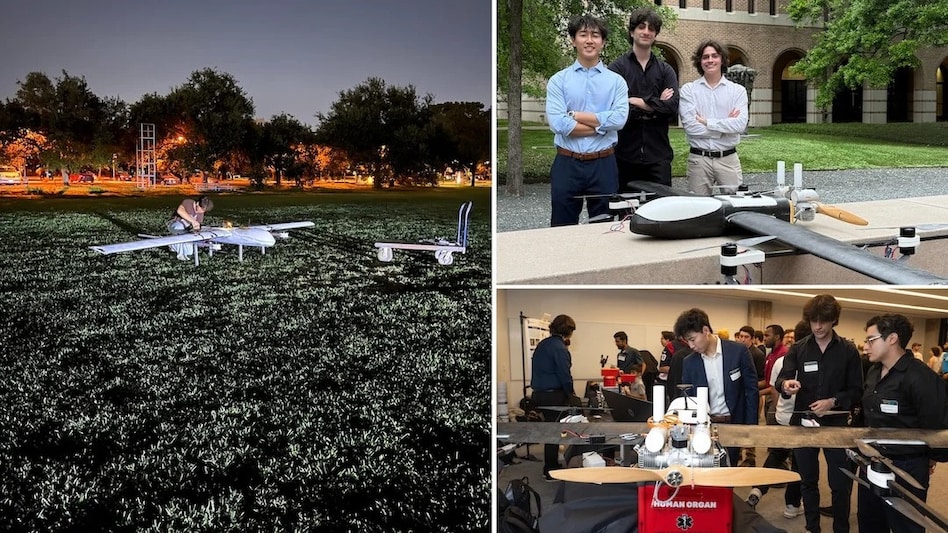
How three American college students raised over $1 million for healthcare startup
A university capstone project has evolved into a groundbreaking healthcare startup with a noble goal. Three graduating students from Rice University—Ege Halac, Jason Chen, and Santiago Brent—have successfully raised $1.85 million in pre-seed funding for their venture, Haast Autonomous. This innovative startup is focused on creating drones designed to swiftly transport essential medical supplies between hospitals and healthcare facilities. During their research, the students found that numerous hospitals still depend on traditional road transport for moving blood samples, medications, laboratory specimens, and emergency supplies. Factors such as traffic congestion, lengthy distances, and inadequate infrastructure often cause delivery delays, especially impacting smaller hospitals and rural healthcare centers. The trio recognized that these delays could have serious consequences for patient care. Determined to tackle one of healthcare's pressing logistical challenges, they shifted their focus away from consumer deliveries to developing a solution that ensures life-critical cargo is moved quickly and safely. “We all knew we wanted to build something together, so in September 2025, we decided to sponsor a capstone design project,” explained co-founder Jason Chen. As engineering students, they seized the opportunity to blend aviation technology, software systems, and healthcare needs into a cohesive solution. Haast Autonomous, aptly named after the Dutch word for “haste,” underscores the urgency required in medical emergencies. The startup has engineered a drone with vertical takeoff and landing capabilities, enabling it to operate directly from existing hospital facilities. This aircraft can cover distances of up to 62 miles while securely transporting sensitive cargo in a specially designed compartment that ensures optimal temperature, pressure, and stability. Co-founder Ege Halac emphasized the necessity for improved transport options, stating, “We need better alternatives for a fast, safe, and on-demand system for life-critical cargo.” The founders are optimistic that their technology will enhance hospitals' ability to receive urgent supplies more swiftly and facilitate the timely transport of patient samples for testing. With their innovative system, biological samples can be transported from remote satellite hospitals to central facilities for analysis, while critical supplies are delivered where they are needed most, ultimately improving patient outcomes. The startup's compelling mission has already garnered significant interest from investors, culminating in a successful $1.85 million funding round. The team aims to launch pilot programs in 2027 and establish a network that enhances the efficiency, reliability, and accessibility of medical logistics.
Kalshi Challenges Netflix Over Controversial Documentary Trailer
Kalshi, the prediction market platform, has taken significant legal steps against Netflix, sending a cease-and-desist le...
TechCrunch | Jul 25, 2026, 17:10
The Shift in Human Cognition: Embracing AI as a Collaborative Tool
As technology continues to evolve, a notable shift is occurring in the relationship between humans and artificial intell...
Business Insider | Jul 25, 2026, 09:50Unlocking the Secrets of Quantum Gravity: Can AI Help Physics Make a Leap?
The realm of scientific research is undergoing a profound transformation, fueled by the rapid advancements in artificial...
Business Today | Jul 25, 2026, 24:30
Unveiling the Future of Finance: TechCrunch Disrupt 2026's Smart Money Stage
The landscape of money is transforming beyond just cash or bank balances, and TechCrunch Disrupt 2026 is set to spotligh...
TechCrunch | Jul 24, 2026, 22:40
Revolutionizing Office Automation: Prentis Aims to Secure $100 Million in Funding
Prentis, a newly established AI research lab, is making waves in the tech industry as it prepares to raise $100 million ...
TechCrunch | Jul 25, 2026, 24:00