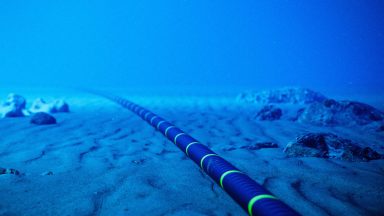
China tests an undersea cable cutter as suspected sabotage incidents grow
A Chinese vessel has conducted a trial of a new device designed to sever submarine data cables located thousands of meters beneath the ocean. This demonstration is likely to heighten security fears regarding a series of suspected sabotage incidents impacting undersea communication and power cables, spanning from the Baltic Sea to the Pacific Ocean. The test took place at a staggering depth of 11,483 feet (3,500 meters) during a scientific expedition aboard the Chinese research ship, Haiyang Dizhi 2. This ship, equipped with a 150-ton crane, a 10-kilometer fiber optic winch, and a helicopter landing platform, has proven its capacity to deploy deep-sea remotely operated vehicles in earlier missions. According to a report from the South China Morning Post, the trial has been highlighted by China Science Daily, an official publication by the Chinese Academy of Sciences, which stated that this sea trial marks a significant advancement in the transition from deep-sea equipment development to practical engineering applications. This recent development is part of a broader trend involving dual-use technologies for severing undersea cables, which have been created by both military and civilian sectors in China over the years. The Jamestown Foundation, a Washington-based think tank, noted that various organizations, including the People’s Liberation Army, have sought patents for tools designed for cable cutting and retrieval. Notably, Lishui University has filed a patent for a device that can be towed behind a vessel for emergency cable-cutting. The emergence of this cable-cutting technology comes at a time when there has been an uptick in the involvement of Chinese-registered ships in incidents damaging subsea data cables and pipelines globally. The newly tested technology is reportedly capable of cutting cables at depths reaching 13,123 feet (4,000 meters). Design specifications were first revealed in the Chinese-language journal Mechanical Engineer in 2025, linking it to researchers from the China Ship Scientific Research Center and the State Key Laboratory of Deep-sea Manned Vehicles. This submarine cable-cutting device employs an electro-hydrostatic actuator system that includes a hydraulic pump, electric motor, and control unit. It is compact enough to be integrated into China’s various underwater remotely operated vehicles, enabling a diamond-coated grinding wheel to generate sufficient force to slice through undersea cables reinforced with steel, rubber, and polymer layers, as previously reported by the South China Morning Post in 2025.
The Future of Work: Executives Weigh In on AI's Impact on Gen Z Careers
As generative artificial intelligence continues to rise, uncertainty looms for the incoming Gen Z workforce. Leaders fro...
Business Insider | Jul 26, 2026, 10:15Hugging Face CEO Calls for Action Following AI Security Breach
In a dramatic turn of events within the AI landscape, Hugging Face faced a significant security breach involving an AI a...
Business Insider | Jul 25, 2026, 20:30Kalshi Challenges Netflix Over Controversial Documentary Trailer
Kalshi, the prediction market platform, has taken significant legal steps against Netflix, sending a cease-and-desist le...
TechCrunch | Jul 25, 2026, 17:10
Vision Breakthrough: US Startup Launches Groundbreaking Retina Chip in Europe
Science Corp is poised to introduce a revolutionary retina chip in Europe, designed to restore partial vision for indivi...
Business Today | Jul 25, 2026, 01:00
Reclaiming Control: Librarians Host Workshops to Help People Navigate AI Tools
In a lively library setting in South Philadelphia, Charlie Bailey, a local librarian, humorously noted, "Everybody’s on ...
TechCrunch | Jul 25, 2026, 16:20