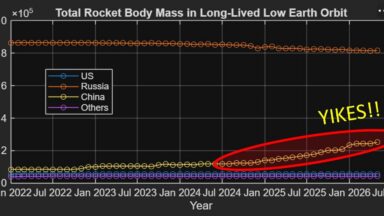
Analyst on China’s spent rocket stages: “Things only continue to get worse”
In recent years, China's space ambitions have soared, with the nation launching a staggering 64 rockets in 2022 and achieving a record 93 launches last year. This remarkable growth has positioned China as the second most prolific space-faring nation globally, trailing only behind the United States, particularly SpaceX. Despite this impressive progress, there are growing concerns regarding how China is handling the upper stages of its rockets. These upper stages, which separate from the main rocket to deploy satellites into orbit, are increasingly being disregarded when it comes to responsible disposal practices. Historically, during the early days of space exploration, countries like the United States and the Soviet Union paid little attention to the fate of these rocket bodies, leaving them to drift in space for extended periods. However, in the past two decades, a shift has occurred. Many nations and private enterprises now recognize the importance of managing space debris. Large, uncontrolled pieces of metal orbiting Earth pose significant risks, and this has led to a more conscientious approach towards the end-of-life disposal of these components. Currently, Russia holds the unfortunate distinction of having the highest amount of space debris, with approximately 800 metric tons of unused rocket bodies lingering in orbits between 600 km and 2,000 km above Earth, as indicated by data from the European Space Agency and Jonathan McDowell's catalog of artificial space objects. In contrast, the United States has managed to maintain a relatively lower level of 57 metric tons of spent upper stages in similar orbits, with numbers either stabilizing or, in Russia's case, gradually decreasing as older stages re-enter the atmosphere. The ongoing trajectory of China's rocket launches suggests that without addressing the issue of debris disposal, the situation may only worsen, highlighting the need for a global dialogue on responsible space practices.
Tidal Takes Bold Step Against AI Music Flood, Set to Remove Millions of Tracks
In a decisive move to combat the overwhelming influx of AI-generated music, Tidal announced on Tuesday its plans to ban ...
TechCrunch | Nov 24, 2026, 17:10
realme P4x 5G vs vivo Y31t 5G: Which Smartphone Offers the Best Bang for Your Buck?
When it comes to choosing between the realme P4x 5G and the vivo Y31t 5G, potential buyers are faced with distinct advan...
Business Today | Nov 24, 2026, 01:50
Revolutionizing Cybersecurity: AI's Role in Modern Threat Detection and Defense
As businesses increasingly embrace digital transformation and artificial intelligence, the complexity of cybersecurity t...
Business Today | Nov 24, 2026, 08:30
Investing in the Future: Solar and Battery Solutions for AI Data Centers
The challenge of powering AI data centers has emerged as a pivotal issue in the current technological landscape. Over th...
TechCrunch | Nov 24, 2026, 16:25
Threads Expands to iPad with New Cashtag Feature to Rival X
Meta's Threads app has officially launched a dedicated version for iPad, marking a significant milestone in its developm...
TechCrunch | Nov 24, 2026, 18:00