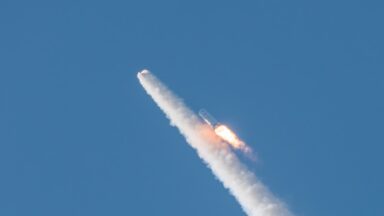
China showcases new Moon ship and reusable rocket in one extraordinary test
China is making significant strides in its space exploration efforts, aiming to send astronauts to the Moon by 2030. In a remarkable demonstration that took place late Tuesday (U.S. time), the nation conducted a test flight featuring a new reusable booster alongside a crew capsule, marking a pivotal advancement in its manned lunar program, according to the China Manned Space Agency (CMSA). This latest test underscores the intensifying competition between China and the United States for lunar exploration, as both nations race to achieve human landings on the Moon for national pride and potential access to lunar resources. Central to China's lunar ambitions are the Long March 10 rocket and the Mengzhou spacecraft, both of which were showcased in this test. The test flight commenced with the Long March 10 booster launching from a newly established pad at the Wenchang Space Launch Site, located in Hainan Island, at 10:00 PM EST on Tuesday (03:00 UTC, which corresponds to 11:00 AM Beijing time on Wednesday). A prototype of the Mengzhou spacecraft, which was uncrewed for this flight, ascended into the stratosphere atop the Long March booster. Shortly after, it activated its launch abort motors just over a minute into the flight, coinciding with the moment of maximum aerodynamic pressure, known as Max-Q. This abort system successfully detached the capsule from the booster, simulating an emergency escape scenario for crew safety in the event of a rocket failure. Following this separation, the Mengzhou capsule deployed its parachutes and safely splashed down off the coast of Hainan Island, completing its mission. In contrast to NASA and SpaceX’s previous in-flight abort tests, where their test boosters were not reusable, the Long March 10 continued its flight path after the Mengzhou's separation. The booster ascended further into space powered by its YF-100 kerosene engines, before re-entering the atmosphere, reigniting its engines, and achieving a successful propulsive landing in the South China Sea, right beside a recovery barge awaiting its return to shore. This successful demonstration not only showcases China's technological advancements but also sets the stage for future manned missions to the Moon.
Nvidia Strikes Major Deal with SK Hynix to Secure AI Memory Supply
Nvidia has successfully forged a significant partnership with South Korea's SK Hynix to secure memory supplies essential...
CNBC | Jul 25, 2026, 05:15
Market Turbulence: Four Key Factors Impacting Stocks This Week
This past week has been challenging for the stock market, driven by several significant forces that have created turbule...
CNBC | Jul 25, 2026, 20:05
Kalshi Challenges Netflix Over Controversial Documentary Trailer
Kalshi, the prediction market platform, has taken significant legal steps against Netflix, sending a cease-and-desist le...
TechCrunch | Jul 25, 2026, 17:10
The Rise of AI Distillation: A Controversial Technique Sparks Debate in Tech and Government
In recent discussions, a once-obscure topic in artificial intelligence has surged to the forefront of debates among tech...
CNBC | Jul 25, 2026, 12:15
The Shift in Human Cognition: Embracing AI as a Collaborative Tool
As technology continues to evolve, a notable shift is occurring in the relationship between humans and artificial intell...
Business Insider | Jul 25, 2026, 09:50