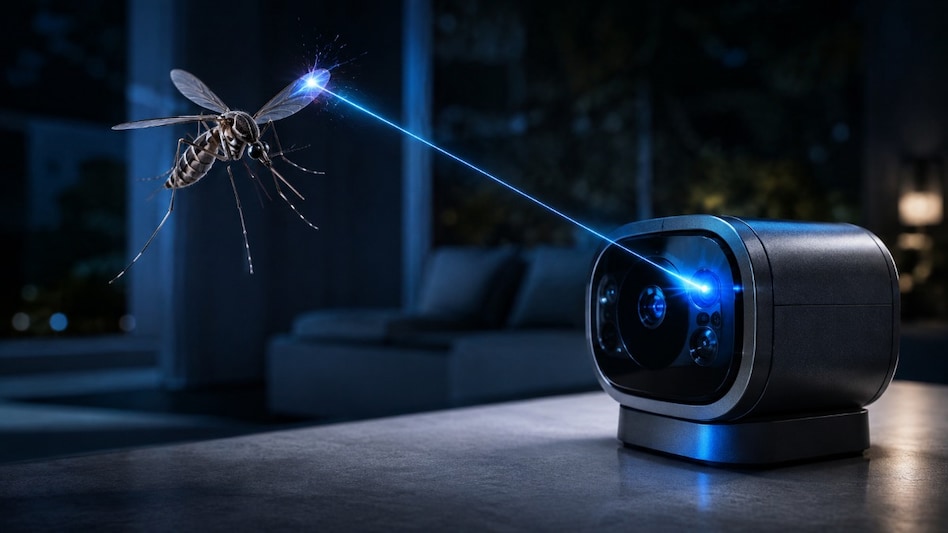
Forget mosquito coils: China is mass-producing a laser that hunts mosquitoes in the air
A groundbreaking device designed to target and eliminate mosquitoes while they fly is transitioning from the prototype phase to mass production in China. Created by Photon Matrix Lab, this innovative portable laser system utilizes advanced sensors, artificial intelligence, and precision lasers to detect and neutralize mosquitoes in real time, according to recent reports. Dubbed as an automated and chemical-free "mosquito air defense" solution, the Photon Matrix system is capable of identifying and disabling mosquitoes and other small flying insects mid-air. The company initiated mass production in August 2026 and has launched an official web store for direct consumer purchases. The laser system comes in two variants: infrared and blue-laser. It employs multiple technologies to accurately identify and track flying insects. Utilizing LiDAR for spatial scanning and distance measurement, the device is further enhanced by millimeter-wave radar to detect motion. An AI vision module then verifies whether the detected object is indeed a small flying target. Once a mosquito is confirmed, a galvanometer-controlled laser locks onto it and releases a short pulse. The manufacturer claims that the laser is typically aimed at the insect's wings, effectively disabling it and causing it to descend. The device scans a wide 90-degree horizontal area, calculating the position of detected insects and directing the laser pulse accordingly. While this technology may seem unconventional, its operational process mirrors that of modern military systems: detect, track, aim, and neutralize. The trend of laser-based weapons is gaining traction as a substitute for traditional ammunition, especially for addressing drone threats and other low-cost aerial challenges. Although consumer mosquito-killing lasers operate at lower power levels, military-grade high-energy lasers (HELs) can deliver substantial energy, enabling them to destroy critical components of drones and missiles. China has been actively developing various laser systems for aerial defense, including the Low-Altitude Laser Defending System (LASS), also known as the Silent Hunter, which is designed to neutralize low-flying drones. Other notable systems include the ‘Shen Nung’ or ‘Shennong,’ which has been deployed for high-profile protection, and naval laser systems tested on vessels like the Type 071 Amphibious Assault Ship. The United States and the UK are also advancing their own high-energy laser systems, with the US's HELIOS successfully test-firing against a drone. Meanwhile, Israel, Russia, and France have been developing their own laser technologies to counter aerial threats, each tailored for specific operational requirements. As the technology continues to evolve, the implications for both consumer and military applications are profound, marking a new era in the fight against airborne threats.
realme P4x 5G vs vivo Y31t 5G: Which Smartphone Offers the Best Bang for Your Buck?
When it comes to choosing between the realme P4x 5G and the vivo Y31t 5G, potential buyers are faced with distinct advan...
Business Today | Nov 24, 2026, 01:50
Supertake Secures $20 Million to Revolutionize AI-Driven Investment Portfolios
Supertake, an innovative AI investing startup, is on a mission to transform how individuals engage with the stock market...
TechCrunch | Nov 23, 2026, 22:10
Revolutionizing Cybersecurity: AI's Role in Modern Threat Detection and Defense
As businesses increasingly embrace digital transformation and artificial intelligence, the complexity of cybersecurity t...
Business Today | Nov 24, 2026, 08:30
Figma Engineer Files Lawsuit Claiming Workplace Harassment and Retaliation
A former engineer at Figma has initiated legal action against the design software firm and its CEO, Dylan Field, citing ...
TechCrunch | Nov 23, 2026, 23:15
Navigating the AI Landscape: Why CEOs Must Embrace Technology Literacy
In the rapidly evolving world of corporate India, companies are increasingly investing in artificial intelligence (AI), ...
Business Today | Nov 24, 2026, 07:35