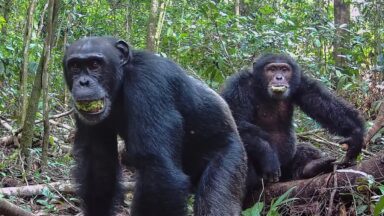
Chimps consume alcohol equivalent of nearly 2 drinks a day
A groundbreaking study led by biologist Robert Dudley from the University of California, Berkeley, has shed light on the alcohol consumption habits of chimpanzees, suggesting a deeper evolutionary connection between humans and alcohol. In his 2014 book, "The Drunken Monkey: Why We Drink and Abuse Alcohol," Dudley introduced the "drunken monkey hypothesis," which posits that the human affinity for alcohol dates back approximately 18 million years to the time of the great apes. Initially met with skepticism, recent observations have confirmed that primates, including chimpanzees, do indeed consume fermented fruits. In a new paper published in the journal Science Advances, Dudley and his colleagues documented their findings from the Ivory Coast and Uganda. They discovered that chimpanzees are ingesting an average of 14 grams of alcohol daily, equivalent to a standard drink in the United States. When accounting for their smaller body size, the study indicates that these primates consume nearly two drinks per day. Earlier this year, researchers captured wild chimpanzees on video sharing fermented African breadfruit, marking the first documented instance of nonhuman great apes sharing alcoholic foods in their natural habitat. The study recorded ten instances of selective sharing among 17 chimps, who showed a strong preference for riper fruit. Between April and July 2022, the team utilized a portable breathalyzer to measure the alcohol content in fallen fruits, revealing that about 90 percent contained ethanol, particularly the ripest varieties which had an alcohol by volume (ABV) of 0.61 percent. While this level is relatively low compared to human alcoholic beverages, it is noteworthy given that fruit constitutes 60 to 80 percent of the chimpanzees' diet. Despite their alcohol intake, the researchers believe it is unlikely that chimps experience drunkenness, as such a state would not provide any evolutionary benefit. Furthermore, evidence suggests that a molecular mechanism inherited from their common ancestor enhances the apes' ability to metabolize alcohol efficiently.
OpenAI's Micro Keypad: A Novelty for Coders or Just a Confounding Gadget?
Last week, OpenAI made its debut in the hardware landscape with the launch of Micro, a stylish keypad designed to integr...
TechCrunch | Jul 25, 2026, 24:40
Finland Unveils World's Largest Sand Battery to Tackle Renewable Energy Challenges
In a groundbreaking move to address the critical issue of renewable energy intermittency, a small town in southern Finla...
CNBC | Jul 25, 2026, 05:35
Warner Bros. Takes Legal Action Against Amazon Over Executive Poaching Allegations
Warner Bros. Discovery has initiated legal proceedings against Amazon, accusing the tech giant of unlawful interference ...
TechCrunch | Jul 25, 2026, 21:25
The Elusive Phineas Fisher: The Hacktivist Who Took Down Spyware Giants
In the realm of cybersecurity, few figures are as intriguing as Phineas Fisher, a hacker who has evaded capture for near...
TechCrunch | Jul 25, 2026, 21:00
Reclaiming Control: Librarians Host Workshops to Help People Navigate AI Tools
In a lively library setting in South Philadelphia, Charlie Bailey, a local librarian, humorously noted, "Everybody’s on ...
TechCrunch | Jul 25, 2026, 16:20