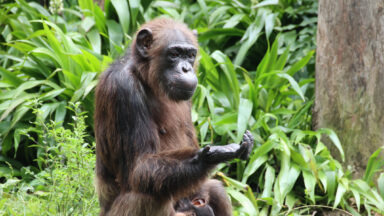
The evolution of rationality: How chimps process conflicting evidence
Aristotle famously posited that what sets humans apart from other animals is our capacity for rational thought, which involves forming beliefs based on evidence and the ability to reconsider that evidence. Jan M. Engelmann, an evolutionary anthropologist at the University of California, Berkeley, echoes this sentiment, highlighting that throughout history, it has been believed that only humans possess true rationality. To challenge this notion, Engelmann designed a study to investigate whether chimpanzees also exhibit rational thinking. The findings revealed that these primates possess a level of rationality comparable to humans. Engelmann noted, "There has been substantial research indicating that chimpanzees can develop beliefs based on the evidence presented to them." In the experiments, chimpanzees were tasked with identifying which of two boxes contained a snack. When researchers manipulated the boxes to create a rattling sound in one, the chimpanzees predominantly selected that box. However, Engelmann pointed out that previous studies had not explored the chimps' capacity to revise their beliefs when confronted with contradictory evidence. Engelmann argues that the ability to adjust beliefs is a critical indicator of rationality, aligning with contemporary understanding in philosophy, psychology, and cognitive science. He remarked, "There are numerous irrational responses to counter-evidence, such as stubbornly holding on to one's beliefs despite contrary proof." To further investigate this, Engelmann and his team examined whether chimpanzees could modify their beliefs based on varying degrees of evidence concerning the food's location. Initially, the research team categorized the evidence presented to the chimpanzees as either weak or strong. Weak evidence might consist of crumbs near one container, while strong evidence could include clear indicators like the sounds of rattling. The initial experiments involved presenting the chimpanzees with weak evidence favoring one box and strong evidence for another, while also manipulating the sequence in which this evidence was presented. The results were telling: when the chimpanzees first selected a box based on initial evidence but were later shown contradicting evidence, they were able to alter their choice accordingly. This ability to reassess and change beliefs underscores the sophisticated cognitive capabilities of chimpanzees, challenging long-held assumptions about rationality being a uniquely human trait.
OpenAI Unveils Innovative Software to Transform Corporate AI Integration
OpenAI has introduced a groundbreaking product named OpenAI Presence, signaling a strategic shift beyond its traditional...
Business Insider | Jul 22, 2026, 12:05Samsung Launches New Foldables as Apple Prepares to Join the Race
The ongoing rivalry between Apple and Samsung in the smartphone arena is set to take a new turn. On Wednesday, Samsung u...
CNN | Jul 22, 2026, 13:10
Nvidia's New Whitelist Strategy: Implications for AI Chip Access in India
AI chips have transitioned from niche computing components to critical assets that underpin technologies like generative...
Business Today | Jul 22, 2026, 10:15
Passionfroot Secures $15 Million to Broaden B2B Creator Marketplace in the U.S.
Passionfroot, a Berlin-based startup connecting B2B creators with brands, has successfully raised $15 million in a Serie...
TechCrunch | Jul 22, 2026, 13:10
Reddit Stock Takes a Hit Amid Concerns Over Google AI Content Deal
Shares of Reddit experienced a significant drop of 9% on Wednesday following a report from the Wall Street Journal indic...
CNBC | Jul 22, 2026, 15:20