Unlocking universe secrets: CERN, Mistral partner on Large Physics Model. What it means?
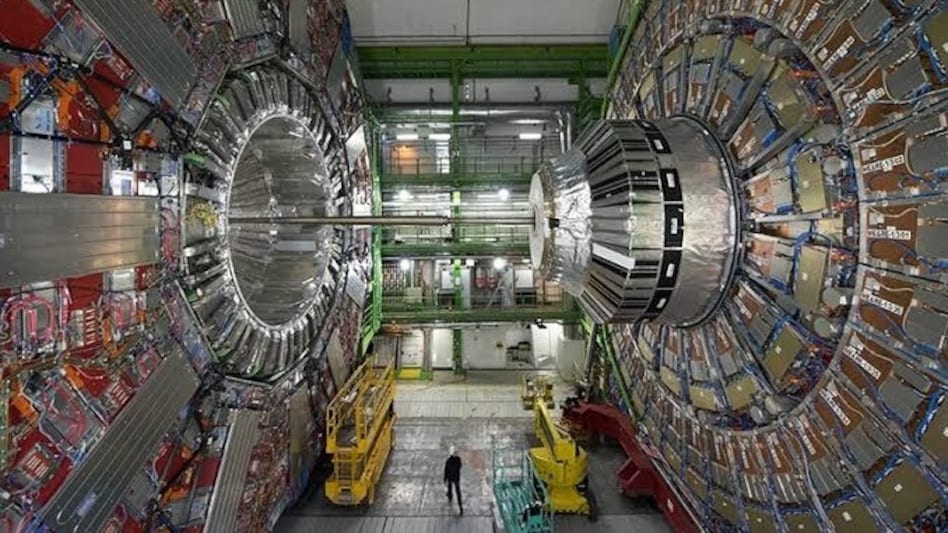
In a groundbreaking collaboration, CERN, Europe's leading scientific research organization, has partnered with Mistral, a prominent player in artificial intelligence development, to create innovative foundation models aimed at unraveling the complexities of particle physics. This strategic alliance merges CERN's vast database of fundamental physics information with Mistral's extensive knowledge in large-scale AI modeling. Central to this partnership is the development of the world's first pretrained Large Physics Model, specifically tailored for collider physics. This model will be trained on an immense dataset comprising billions of simulated proton-proton collisions sourced from the Large Hadron Collider (LHC). The initiative seeks to enhance data reconstruction processes, improve particle identification, detect anomalies, and refine future detector designs. As CERN gears up for the High-Luminosity LHC, which is expected to escalate collision rates tenfold by 2030, addressing the increasing intricacies of data analysis has become paramount. Enrica Porcari, CERN's Chief Information Officer, emphasized the unique opportunity that high-energy physics provides for the development and rigorous testing of artificial intelligence technologies. She stated, "We are partnering with Mistral, a leading European AI company, to advance AI capabilities that can serve the whole physics community and be shared." This collaboration signifies a transformative shift in the methodology researchers use to interpret experimental data. Traditionally, event reconstruction has depended on a sequential process involving various specialized algorithms that convert raw detector signals into analyzable physical entities. While machine learning has contributed to specific tasks within this framework, the new foundation models will have the ability to learn from the entire reconstruction chain simultaneously, thus supporting multiple workflows within a unified architecture. Currently, CERN manages around one exabyte of experimental data produced by the LHC. With the anticipated transition to the High-Luminosity LHC by 2030, the influx of particle collision data is expected to increase significantly. This surge presents an exceptional testing ground for advanced machine learning applications. Johannes Brandstetter, Vice-President of AI for Engineering at Mistral, expressed enthusiasm for the partnership, stating, "We are proud to work with CERN to explore what large-scale AI models can bring to the growing complexity of particle physics. Together, we have the opportunity to push the frontiers of high-energy physics, developing AI capabilities that have the potential to lead to new scientific discoveries."
Megaspeed Faces U.S. Blacklisting Amid Espionage Allegations
Megaspeed, a company formerly led by Alice Huang, is reportedly set to be added to the U.S. Commerce Department's Entity...
TechCrunch | Nov 23, 2026, 21:45
Pinterest Empowers Parents with New Controls Over AI Content for Teens
This week, Pinterest unveiled an enhancement to its parental controls, introducing a feature that allows parents to regu...
TechCrunch | Nov 24, 2026, 16:25
Figma Engineer Files Lawsuit Claiming Workplace Harassment and Retaliation
A former engineer at Figma has initiated legal action against the design software firm and its CEO, Dylan Field, citing ...
TechCrunch | Nov 23, 2026, 23:15
Emerging AI Chip Design Revolution: A Challenge to Nvidia's Reign
Nvidia, under the leadership of Jensen Huang, faces a significant challenge from the very AI technology it helped to pop...
Business Insider | Nov 24, 2026, 10:10Investing in the Future: Solar and Battery Solutions for AI Data Centers
The challenge of powering AI data centers has emerged as a pivotal issue in the current technological landscape. Over th...
TechCrunch | Nov 24, 2026, 16:25