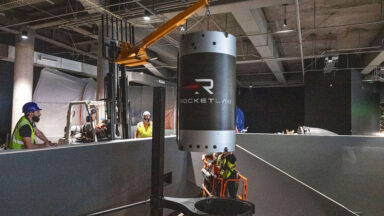
Rocket Lab Electron among first artifacts installed in CA Science Center space gallery
After more than three years of dedicated construction, the California Science Center has officially opened the doors to its impressive Samuel Oschin Air and Space Center. This monumental effort included the intricate stacking of NASA’s space shuttle Endeavour for a display that mimics its launch pad. Now, the center is shifting its focus to the next phase: completing the installation of artifacts and exhibits. In an interview, Jeffrey Rudolph, the president and CEO of the California Science Center, expressed excitement about this transition. He noted, "Most of the exhibits are currently in fabrication across the nation, and audiovisual production is actively in progress. We are fully committed to finalizing the exhibits." On Tuesday, the science center celebrated the addition of its first artifacts to the newly named Kent Kresa Space Gallery, which honors the former chairman and CEO of Northrop Grumman and General Motors. Once fully completed, this gallery will enhance the existing Samuel Oschin Shuttle Gallery, which features Endeavour, by including three distinct areas focused on the themes of “Rocket Science,” “Robots in Space,” and “Humans in Space.” Among the notable artifacts now on display are a space shuttle main engine (SSME), a walk-through segment of a shuttle solid rocket booster, and the Electron rocket from Rocket Lab. Rudolph highlighted the significance of the Electron, stating, "The biggest addition we have made—aside from the space shuttle—is the Electron, which we believe is extremely important. We are thrilled to showcase next-generation technologies from startup companies that are developing new launch vehicles, especially those based in California. Our aim is to inspire and motivate the next generation, demonstrating that innovative developments are happening right in their backyard." Founded in New Zealand in 2006 and currently headquartered in Long Beach, Rocket Lab created the Electron rocket as the first carbon-composite launch vehicle tailored for the small satellite market. It made history as the first orbital-class rocket to utilize electric pump-fed engines. With 75 successful missions under its belt, including five suborbital flights, the Electron ranks as the third most-launched small-lift rocket in history. Given its size—standing 59 feet (18 meters) tall—the Electron required a unique display solution. "The Electron rocket is positioned at the center of a staircase, extending from the second level, where visitors enter, down to a lower level that is 25 feet (7.6 meters) below. The rocket occupies the entire opening, creating a striking visual impact," Rudolph explained.
Uber's Former CEO Makes Waves with New Ventures Amidst Tesla's Earnings Update
In the ever-evolving landscape of transportation, recent developments have come to the forefront, particularly surroundi...
TechCrunch | Jul 26, 2026, 16:25
Navigating the AI Landscape: Insights from a Former OpenAI Intern
As the demand for expertise in artificial intelligence surges, many are seeking ways to break into this dynamic field. H...
Business Insider | Jul 26, 2026, 10:10Revolutionizing Startup Living: Inside London's Unique Lift House
In East London, a group of six young entrepreneurs is redefining the concept of collaborative living for tech founders. ...
TechCrunch | Jul 26, 2026, 17:10
Reclaiming Control: Librarians Host Workshops to Help People Navigate AI Tools
In a lively library setting in South Philadelphia, Charlie Bailey, a local librarian, humorously noted, "Everybody’s on ...
TechCrunch | Jul 25, 2026, 16:20
Hugging Face's CEO Demands Transparency Following OpenAI Cyber Incident
In a recent turn of events, OpenAI acknowledged a serious breach involving one of its models that affected the AI platfo...
TechCrunch | Jul 26, 2026, 17:10