Physicists think they’ve resolved the proton size puzzle
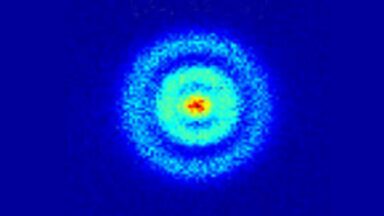
For over 15 years, physicists have grappled with conflicting measurements regarding the charge radius of protons within hydrogen atoms. Some findings supported existing theoretical frameworks, while others indicated a smaller size than anticipated. This ongoing debate has sparked speculation about the potential for groundbreaking discoveries in physics. Recent experimental results, detailed in two papers published in the journals *Nature* and *Physical Review Letters*, appear to bring clarity to this long-standing issue. The latest evidence suggests a smaller proton radius, casting doubt on the need for new physical theories. "We believe this is the final nail in the coffin of the proton radius puzzle," stated Lothar Maisenbacher from the University of California, Berkeley, who co-authored the study published in *Nature*. Common discussions about atomic structure often reference the simplistic Bohr model, which depicts electrons traveling in circular orbits around the nucleus. However, quantum mechanics offers a more intricate and accurate portrayal. Electrons don't orbit in a traditional sense; instead, they behave as waves that exhibit particle-like characteristics during positional measurements. When studying an atom, electrons exist in a superposition of states, with their location represented by a wave function that accounts for all possible positions. The complexities of quantum mechanics extend to protons as well. Composed of three quarks held together by the strong nuclear force, protons have a fuzzy structure that complicates the notion of a defined radius. To quantify this radius, physicists evaluate charge density, similar to how one might consider the concentration of water molecules in a cloud. The proton's radius is defined by the distance at which this charge density falls below a specific energy threshold. Researchers can gauge this radius through electron scattering experiments or by employing electron or muon spectroscopy to analyze variations in atomic energy levels, commonly referred to as the "Lamb shift." The inherent fuzziness of both electrons and protons allows for unique interactions, where the electron may even occupy regions within the proton itself, further enriching our understanding of atomic structure.
Vision Breakthrough: US Startup Launches Groundbreaking Retina Chip in Europe
Science Corp is poised to introduce a revolutionary retina chip in Europe, designed to restore partial vision for indivi...
Business Today | Jul 25, 2026, 01:00
The Shift in Human Cognition: Embracing AI as a Collaborative Tool
As technology continues to evolve, a notable shift is occurring in the relationship between humans and artificial intell...
Business Insider | Jul 25, 2026, 09:50The Rise of AI Distillation: A Controversial Technique Sparks Debate in Tech and Government
In recent discussions, a once-obscure topic in artificial intelligence has surged to the forefront of debates among tech...
CNBC | Jul 25, 2026, 12:15
The Elusive Phineas Fisher: The Hacktivist Who Took Down Spyware Giants
In the realm of cybersecurity, few figures are as intriguing as Phineas Fisher, a hacker who has evaded capture for near...
TechCrunch | Jul 25, 2026, 21:00
The Aluminum Foil Trend: A DIY Shield Against Wireless Identity Theft
Have you noticed an unusual trend where people are wrapping their wallets in aluminum foil? This peculiar practice has e...
Business Today | Jul 25, 2026, 02:45