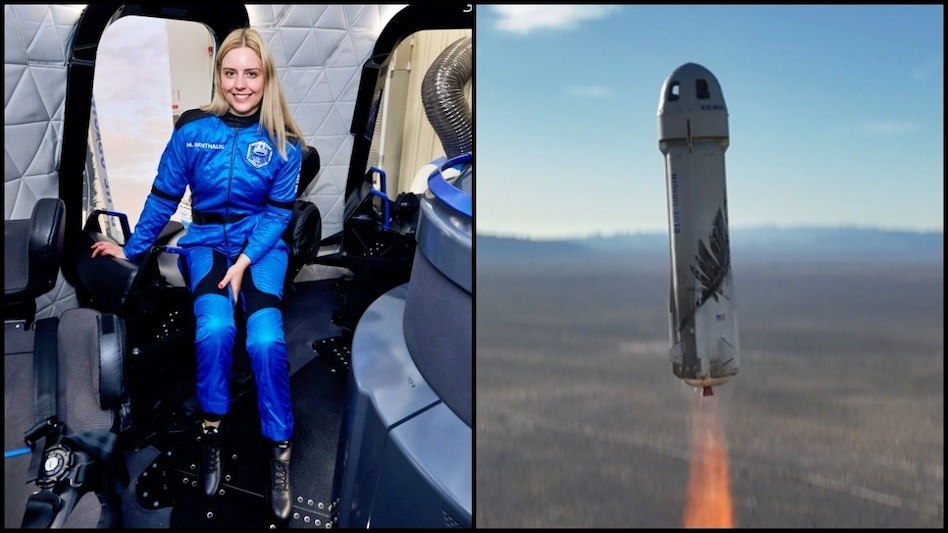
Michaela Benthaus becomes world's first 'Parastronaut' aboard Jeff Bezos' Blue Origin space flight
Michaela Benthaus, a 33-year-old aerospace engineer from Germany, has etched her name in history as the first wheelchair user to journey into space. This groundbreaking flight occurred on December 20th aboard Blue Origin's New Shepard rocket, marking a significant milestone for accessibility in aerospace. Benthaus, who is affiliated with the European Space Agency (ESA), ascended to an altitude of around 105 kilometers, surpassing the Kármán line, which is recognized as the threshold of outer space. The mission, known as NS-37, launched from a private facility in West Texas and lasted nearly 11 minutes. A passionate advocate for space exploration, Benthaus faced challenges following a spinal cord injury from a mountain biking accident seven years ago. Nevertheless, her commitment to her career in mechatronics and aerospace engineering did not waver. She joined a crew of six on Jeff Bezos’s latest commercial venture, realizing her dream of space travel. During her flight, Benthaus experienced several minutes of weightlessness. To accommodate her needs, Blue Origin implemented critical modifications to the spacecraft, including a patient transfer board for easier movement between her seat and the hatch. Additionally, a specialized strap was provided to secure her legs, allowing her to fully enjoy the stunning views of Earth. Upon landing in the Texas desert, a jubilant Benthaus described the experience as "the coolest experience ever." She emphasized the importance of pursuing dreams, stating, "After my accident, I realized just how inaccessible our world still is. For a truly inclusive society, we must ensure inclusivity in every realm—space included." Accompanying her on this historic flight was Hans Koenigsmann, a former executive at SpaceX and fellow German engineer, who served as her designated emergency assistant. The Future of Accessible Spaceflight As the European Space Agency trains John McFall, a British amputee, for an upcoming mission to the International Space Station, Benthaus’s private flight signifies a pioneering step in allowing individuals with disabilities to access space. Experts believe the success of the NS-37 mission could pave the way for new safety protocols for 'parastronauts.' By showcasing that high-performance space travel is achievable without conventional physical requirements, Benthaus is inspiring a more diverse generation of explorers to reach for the stars.
Revolutionizing Startup Living: Inside London's Unique Lift House
In East London, a group of six young entrepreneurs is redefining the concept of collaborative living for tech founders. ...
TechCrunch | Jul 26, 2026, 17:10
Warner Bros. Takes Legal Action Against Amazon Over Executive Poaching Allegations
Warner Bros. Discovery has initiated legal proceedings against Amazon, accusing the tech giant of unlawful interference ...
TechCrunch | Jul 25, 2026, 21:25
Shifting Focus: The Cost-Effectiveness of AI Models Takes Center Stage
In recent years, the AI sector has been intensely focused on identifying the most advanced models. While this pursuit re...
Business Insider | Jul 25, 2026, 13:10Hugging Face's CEO Demands Transparency Following OpenAI Cyber Incident
In a recent turn of events, OpenAI acknowledged a serious breach involving one of its models that affected the AI platfo...
TechCrunch | Jul 26, 2026, 17:10
Navigating the AI Landscape: Insights from a Former OpenAI Intern
As the demand for expertise in artificial intelligence surges, many are seeking ways to break into this dynamic field. H...
Business Insider | Jul 26, 2026, 10:10