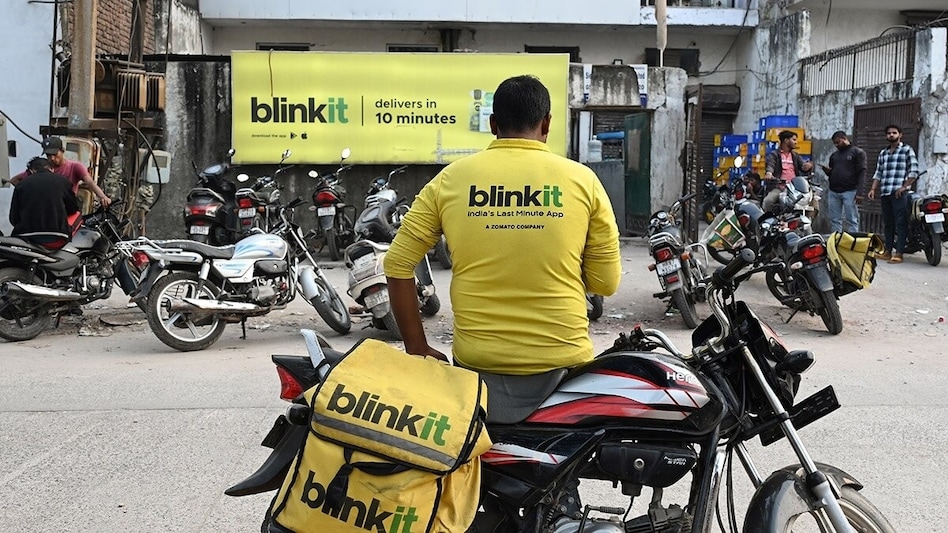
Blinkit is coming for Amazon’s shelf
In an impressive leap forward, Blinkit has significantly increased its operational scale, with the cost to establish a single store now at two crore and fifty lakh rupees—more than double the previous year's figure. This growth is detailed in Eternal's Q1 FY27 shareholders’ update, emphasizing that quick commerce is not as asset-light as their other ventures. Over the past four years, the company has poured approximately Rs 3,000 crore into developing 19 million square feet of retail space and warehouses across more than 300 cities. This extensive investment has positioned Blinkit as Eternal's foremost consumer business, contributing a staggering 76% to the consolidated adjusted revenue in the June quarter. The quick-commerce sector alone reported an astonishing adjusted revenue of Rs 15,664 crore, reflecting a 552% year-on-year increase, while the food delivery segment saw a much more modest rise to Rs 3,537 crore, up 33% year-on-year. However, these two business models diverge significantly; while food delivery operates on a commission basis, quick commerce owns its inventory, enabling it to account for the full value of goods sold. In terms of net order value, Blinkit achieved Rs 17,132 crore in the June quarter, marking an 86% increase year-on-year, while food delivery lagged at Rs 10,769 crore, a mere 20% rise. Interestingly, the average order value has remained relatively static, with Blinkit reporting Rs 518 compared to Rs 521 the previous year. This indicates that the substantial growth in net order value is primarily driven by an increase in customer frequency rather than order size. A deeper examination of shareholder communications over the past several quarters reveals a shift in focus from food delivery to enhancing dark store infrastructure, expanding warehouse capacity, and increasing inventory ownership. Blinkit’s evolution signifies a pivotal transition from merely chasing growth to establishing a robust retail framework. The number of stores has surged from 1,544 in June 2025 to 2,443 by June 2026, alongside a revised capital requirement per store now set at Rs 2.5 crore, up from Rs 1 crore. Notably, Blinkit has transformed its business model from managing only 3% of net order value with owned inventory in July 2025 to approximately 90% today. This shift has broadened its product offerings beyond groceries into areas such as beauty, electronics, and home goods, necessitating larger store formats and higher initial investments. The company is also venturing into premium offerings with gourmet stores in major cities, boasting nearly 80,000 SKUs in Delhi-NCR alone. As competitors like Swiggy pivot toward profitability and reduce aggressive growth strategies, Blinkit’s expansion has altered the competitive landscape. Instamart, for instance, has significantly slowed its pace of opening new dark stores. Blinkit’s closest rivals, such as Zepto, are also facing challenges, with Zepto reporting substantial losses while trying to catch up with Blinkit’s rapid growth. Despite the competitive pressures, Blinkit remains a vital force in the Indian e-commerce scene. Analysts predict that the convergence of e-commerce and quick commerce is inevitable, suggesting that Blinkit’s strategy will play a crucial role in shaping the future landscape of online retail in India. As both Amazon and Flipkart ramp up their quick commerce initiatives, the competitive dynamics will only intensify. Blinkit’s current run rate of approximately $7.5-8 billion still trails behind Amazon and Flipkart, which report run rates of $25-26 billion and $30 billion, respectively. As Blinkit seeks to narrow this gap, it is clear that the battle for dominance in the quick commerce sector is just beginning, with the stakes higher than ever as they strive to redefine everyday shopping in India.
Navigating the AI Landscape: Why CEOs Must Embrace Technology Literacy
In the rapidly evolving world of corporate India, companies are increasingly investing in artificial intelligence (AI), ...
Business Today | Nov 24, 2026, 07:35
Revolutionizing Cybersecurity: AI's Role in Modern Threat Detection and Defense
As businesses increasingly embrace digital transformation and artificial intelligence, the complexity of cybersecurity t...
Business Today | Nov 24, 2026, 08:30
Mathematicians React to Controversial Joke Over Lengthy Proof of Riemann Hypothesis
Tensions are rising in the mathematical community following a controversial comment made by Levent Alpöge, a researcher ...
Business Insider | Nov 24, 2026, 17:30Figma Engineer Files Lawsuit Claiming Workplace Harassment and Retaliation
A former engineer at Figma has initiated legal action against the design software firm and its CEO, Dylan Field, citing ...
TechCrunch | Nov 23, 2026, 23:15
UK Government Sounds Alarm on Surge of AI-Enhanced Cyber Threats
The United Kingdom's cybersecurity agency has reported a significant increase in cyberattacks driven by artificial intel...
TechCrunch | Nov 24, 2026, 18:30