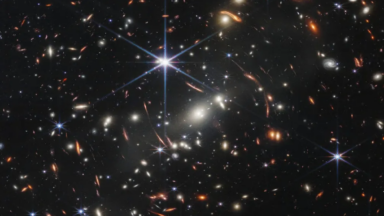
Gravitational lens shows a galaxy just 800 million years post-Big Bang
For many years, astronomers have aimed to explore the distant epoch when the universe's earliest stars began to shine. Despite their efforts with powerful telescopes like Hubble, the faint light from the small galaxies that formed the foundation of our cosmic landscape proved elusive. However, a breakthrough has emerged thanks to the James Webb Space Telescope (JWST) and a stroke of good fortune. In a recent publication in the journal Nature, a team led by Kimihiko Nakajima from Kanazawa University, Japan, reported their observations of an ultra-faint galaxy designated LAP1-B. This galaxy existed approximately 800 million years after the Big Bang, making it the most chemically primitive galaxy ever detected. Located an astonishing 13 billion light-years away from Earth, LAP1-B's faintness posed a significant challenge for detection. To identify such a distant and dim object, the JWST's impressive gold-coated beryllium mirrors required additional assistance. The crucial factor was the presence of a massive galaxy cluster known as MACS J046, which distorts the fabric of spacetime between Earth and LAP1-B. Nakajima noted, "The galaxy was strongly magnified through the gravitational lensing effect." This phenomenon enabled light from LAP1-B to be magnified roughly 100 times as it traveled towards our planet. Despite this remarkable enhancement, LAP1-B remained so faint that neither the JWST nor Hubble could capture its stellar continuum, the constant background light emitted by its stars. Nevertheless, the team used this information to make significant calculations. By considering the distance to LAP1-B and the sensitivity of the telescopes, they established that the galaxy's stellar mass must be capped at around 3,300 solar masses—minuscule when compared to the Milky Way's estimated 100 billion solar masses. This discovery not only sheds light on the early universe but also emphasizes the immense challenges astronomers face in observing the cosmos's formative years.
Hugging Face CEO Calls for Action Following AI Security Breach
In a dramatic turn of events within the AI landscape, Hugging Face faced a significant security breach involving an AI a...
Business Insider | Jul 25, 2026, 20:30Warner Bros. Takes Legal Action Against Amazon Over Executive Poaching Allegations
Warner Bros. Discovery has initiated legal proceedings against Amazon, accusing the tech giant of unlawful interference ...
TechCrunch | Jul 25, 2026, 21:25
SpaceX Successfully Tests Starship Rocket, Launching New Era of Space Exploration
On Friday evening, SpaceX executed a significant milestone by launching its colossal Starship rocket from its facility i...
CNBC | Jul 25, 2026, 24:10
The Elusive Phineas Fisher: The Hacktivist Who Took Down Spyware Giants
In the realm of cybersecurity, few figures are as intriguing as Phineas Fisher, a hacker who has evaded capture for near...
TechCrunch | Jul 25, 2026, 21:00
The Rise of AI Distillation: A Controversial Technique Sparks Debate in Tech and Government
In recent discussions, a once-obscure topic in artificial intelligence has surged to the forefront of debates among tech...
CNBC | Jul 25, 2026, 12:15