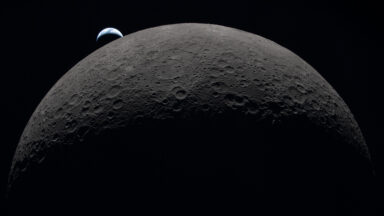
The Moon is already on Google Maps—did Artemis II really tell us anything new?
NASA's Artemis II mission has made headlines after its spacecraft, Orion, successfully established a laser communication link with Earth shortly after passing behind the Moon on Monday night. This connection allowed for a significant data transmission, with high-resolution images streaming back to Earth. The first images were made public on Tuesday, showcasing stunning views captured by the Artemis II crew. The four astronauts—Reid Wiseman, Victor Glover, Christina Koch, and Jeremy Hansen—used handheld Nikon cameras equipped with both wide-angle and telephoto lenses, as well as iPhones, to document their journey aboard the Orion, aptly named Integrity. As they reached the farthest point from Earth, the crew began their return journey, set for reentry and splashdown on Friday evening, marking the conclusion of the first crewed lunar mission in over five decades. Throughout their lunar flyby, the astronauts shared their experiences via radio, alternating between technical descriptions and heartfelt expressions of wonder at the views unfolding before them. The excitement was palpable among geologists and scientists at NASA’s Mission Control in Houston, as this marked humanity's first exploration of another celestial body in almost 54 years. One of the remarkable aspects of this mission was the opportunity for the crew to observe areas of the Moon's far side that had previously only been seen by robotic missions. However, it’s important to note that these robotic explorers have been equipped with advanced scientific instruments, including laser altimeters and magnetometers, allowing them to analyze the Moon in-depth across various wavelengths of light. Unlike the Artemis II mission, these robotic spacecraft have been studying the Moon for decades, uncovering significant findings such as the presence of water ice in craters at the lunar south pole, a key factor in future human exploration plans.
UK Government Sounds Alarm on Surge of AI-Enhanced Cyber Threats
The United Kingdom's cybersecurity agency has reported a significant increase in cyberattacks driven by artificial intel...
TechCrunch | Nov 24, 2026, 18:30
Amazon's $7.5 Billion Acquisition of Decart: A Strategic Move in the AI Chip Landscape
In a significant development for the tech industry, Amazon has announced its acquisition of Decart, a startup specializi...
TechCrunch | Nov 24, 2026, 15:55
Investing in the Future: Solar and Battery Solutions for AI Data Centers
The challenge of powering AI data centers has emerged as a pivotal issue in the current technological landscape. Over th...
TechCrunch | Nov 24, 2026, 16:25
The Complex Journey of Jensen and Lori Huang: Love, Challenges, and Triumphs
Jensen Huang, the prominent CEO of Nvidia, and his wife Lori have navigated a journey filled with personal and professio...
Business Insider | Nov 24, 2026, 19:05Instagram Integrates AI Assistant Muse for Enhanced User Experience
In a significant move, Meta has announced the integration of its AI assistant, Muse, directly into Instagram's direct me...
TechCrunch | Nov 24, 2026, 17:25