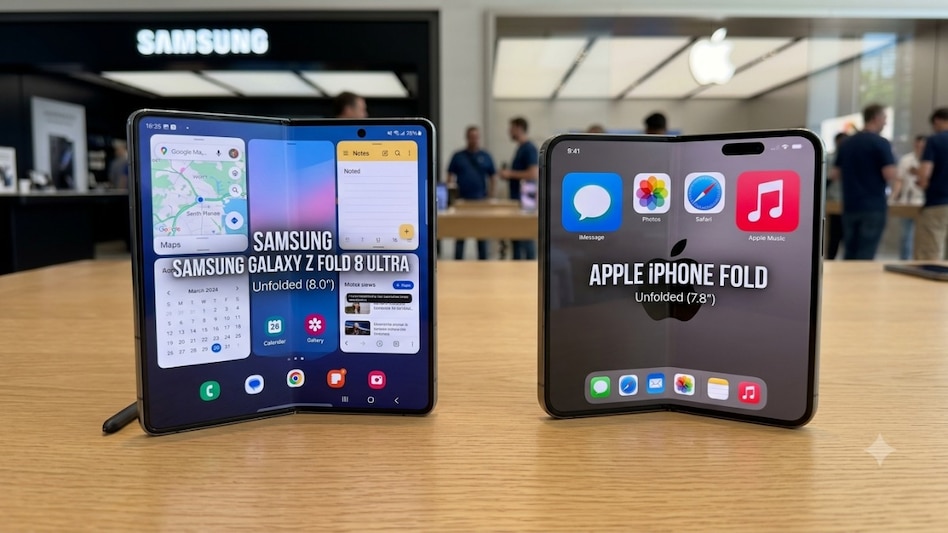
iPhone Ultra vs Galaxy Z Fold 8 Ultra: Can Apple finally challenge Samsung’s dominance in foldable market?
This September marks a significant moment in the smartphone industry as Apple prepares to launch the iPhone Ultra, its first foray into the foldable market. Although entering the scene later than its competitors, Apple aims to create a formidable contender against Samsung's Galaxy Z Fold 8 Ultra, which is scheduled to debut in July 2026. Foldable devices have primarily attracted a niche audience, catering mainly to power users. Despite their unique appeal, these smartphones come with challenges that Samsung has managed to address over the years. The critical question now is whether Apple can reclaim its market dominance with this new release. Design-wise, the iPhone Ultra is rumored to adopt a wallet-style fold, distinguishing itself from the Galaxy Z Fold 8 Ultra's book-style design. This difference means that the iPhone will likely have a broader and shorter profile. Reports suggest that the iPhone Ultra will feature a flat frame, a glass back, and a sophisticated hinge mechanism for seamless folding. In contrast, the Galaxy Z Fold 8 Ultra is expected to maintain a similar aesthetic to its predecessor, boasting an aluminum chassis, a triple camera array on the back, and a sleek profile—approximately 4.1mm thick compared to the iPhone Ultra's anticipated 4.8mm. When it comes to displays, the iPhone Ultra could sport a 5.5-inch Liquid Retina XDR OLED cover display enhanced with ProMotion technology for a smooth 120Hz refresh rate, alongside a larger 7.8-inch inner display. Meanwhile, the Galaxy Z Fold 8 Ultra is likely to feature a 6.5-inch Dynamic AMOLED display, also with a 120Hz refresh rate, and an 8-inch internal screen. A key point of comparison will be how well each device handles the crease typically associated with foldable displays. In terms of camera capabilities, the Galaxy Z Fold 8 Ultra is expected to house a robust triple camera setup, potentially including a 200MP main sensor, a 50MP ultra-wide lens, and a 10MP telephoto lens with 3x optical zoom. On the other hand, the iPhone Ultra may come equipped with a dual-camera system, featuring a 48MP primary camera and a 12MP ultra-wide lens. Performance specifications reveal that the iPhone Ultra will likely be powered by an A20 Pro chip fabricated using TSMC’s advanced 2nm process, coupled with 12GB of RAM. The Galaxy Z Fold 8 Ultra, however, is anticipated to utilize the Snapdragon 8 Elite Gen 5 for Galaxy processor along with up to 16GB of RAM. Battery-wise, the iPhone Ultra may include a dual-cell 5,500 mAh battery, while the Galaxy Z Fold 8 Ultra is expected to have a 5,000 mAh battery, indicating competitive longevity for both devices.
Investing in the Future: Solar and Battery Solutions for AI Data Centers
The challenge of powering AI data centers has emerged as a pivotal issue in the current technological landscape. Over th...
TechCrunch | Nov 24, 2026, 16:25
realme P4x 5G vs vivo Y31t 5G: Which Smartphone Offers the Best Bang for Your Buck?
When it comes to choosing between the realme P4x 5G and the vivo Y31t 5G, potential buyers are faced with distinct advan...
Business Today | Nov 24, 2026, 01:50
Mathematicians React to Controversial Joke Over Lengthy Proof of Riemann Hypothesis
Tensions are rising in the mathematical community following a controversial comment made by Levent Alpöge, a researcher ...
Business Insider | Nov 24, 2026, 17:30Revolutionizing Cybersecurity: AI's Role in Modern Threat Detection and Defense
As businesses increasingly embrace digital transformation and artificial intelligence, the complexity of cybersecurity t...
Business Today | Nov 24, 2026, 08:30
Navigating the AI Landscape: Why CEOs Must Embrace Technology Literacy
In the rapidly evolving world of corporate India, companies are increasingly investing in artificial intelligence (AI), ...
Business Today | Nov 24, 2026, 07:35