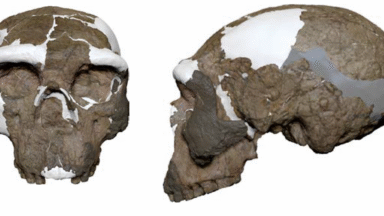
Is the “million-year-old” skull from China a Denisovan or something else?
A recently uncovered skull from China is igniting discussions about our ancient relatives. Known as Yunxian 2, this fossil has been dated to between 600,000 and 1 million years old and was found alongside the Han River. Initially categorized as Homo erectus by archaeologists, new research led by Xiaobo Feng from Hanjiang Normal University suggests it might actually belong to a group more closely related to Denisovans. The study employed advanced digital reconstruction techniques to analyze Yunxian 2, revealing features that resemble a 146,000-year-old Denisovan skull found in Harbin, China. This earlier discovery had sparked its own controversy, as researchers proposed it could represent a completely new species, Homo longi, distinct from Neanderthals and Denisovans. The ongoing research is further complicated by the existence of a third skull from the same excavation site, which has yet to be published. As scientists piece together these ancient remnants, they are not only reconstructing physical forms but also unraveling the intricate narrative of human evolution, highlighting the potential links between different hominin species. The findings emphasize the complexity of our ancestry and the continuous quest for understanding where we fit in the broader story of human history.
The Aluminum Foil Trend: A DIY Shield Against Wireless Identity Theft
Have you noticed an unusual trend where people are wrapping their wallets in aluminum foil? This peculiar practice has e...
Business Today | Jul 25, 2026, 02:45
Vietnam's Controversial Social Media Proposal: A New Approach for Youth Engagement
Vietnam is contemplating a distinctive approach to youth social media regulations, diverging from the more common outrig...
TechCrunch | Jul 24, 2026, 21:25
SpaceX's Latest Starlink Launch Marks Milestone Amid Booster Setbacks
On Friday, SpaceX marked a significant achievement by successfully launching its first batch of third-generation Starlin...
TechCrunch | Jul 24, 2026, 23:40
OpenAI's Micro Keypad: A Novelty for Coders or Just a Confounding Gadget?
Last week, OpenAI made its debut in the hardware landscape with the launch of Micro, a stylish keypad designed to integr...
TechCrunch | Jul 25, 2026, 24:40
Alphabet Takes the Lead in AI Investment Amid Industry Competition
In a bold move that underscores its commitment to artificial intelligence, Alphabet has significantly ramped up its spen...
CNBC | Jul 24, 2026, 19:45