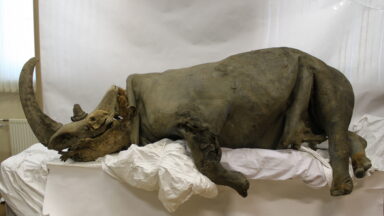
Scientists sequence a woolly rhino genome from a 14,400-year-old wolf’s stomach
In a groundbreaking discovery, scientists have sequenced the genome of the woolly rhinoceros from the remains of a 14,400-year-old wolf puppy's last meal. Researchers examining the mummified remains of this Ice Age wolf found a partially digested piece of meat in its stomach, which has been identified as a prime cut of woolly rhinoceros. The woolly rhinoceros, a colossal creature that weighed around two metric tons, once roamed the tundras of Europe and Asia. Led by Sólveig Guðjónsdóttir from Stockholm University, the team successfully sequenced a complete genome from the preserved meat, unraveling insights into the woolly rhino populations just before their extinction. "Sequencing the entire genome of an Ice Age animal found in the stomach of another animal has never been done before," stated Uppsala University paleogeneticist Camilo Chacón-Duque, who is a coauthor of the study. The wolf puppy, along with its sibling, was discovered eroding from the permafrost near the Siberian village of Tumat in 2011 and 2015. When the remains were brought to a laboratory for analysis in 2022, researchers found fragments of the last meal still intact within the stomach. DNA analysis confirmed the meat's origin as that of the woolly rhinoceros (scientifically known as Coelodonta antiquitatis) and identified the puppies as wolves rather than domestic dogs. Extracting a full genome from such ancient and degraded DNA posed significant challenges. After millennia in the permafrost, the DNA had fragmented, leaving only small and damaged strands. Additionally, differentiating between the genetic material of the wolf and the rhino was a complex task. The analysis revealed that the woolly rhinoceros came from a genetically robust population, which avoided the pitfalls of inbreeding. Inbreeding typically manifests as long stretches of homozygous genes, but the DNA from the Tumat rhino showed no such signs, indicating a healthy genetic diversity in its lineage.
The Shift in Human Cognition: Embracing AI as a Collaborative Tool
As technology continues to evolve, a notable shift is occurring in the relationship between humans and artificial intell...
Business Insider | Jul 25, 2026, 09:50The Elusive Phineas Fisher: The Hacktivist Who Took Down Spyware Giants
In the realm of cybersecurity, few figures are as intriguing as Phineas Fisher, a hacker who has evaded capture for near...
TechCrunch | Jul 25, 2026, 21:00
Hugging Face CEO Calls for Action Following AI Security Breach
In a dramatic turn of events within the AI landscape, Hugging Face faced a significant security breach involving an AI a...
Business Insider | Jul 25, 2026, 20:30The Rise of AI Distillation: A Controversial Technique Sparks Debate in Tech and Government
In recent discussions, a once-obscure topic in artificial intelligence has surged to the forefront of debates among tech...
CNBC | Jul 25, 2026, 12:15
Reclaiming Control: Librarians Host Workshops to Help People Navigate AI Tools
In a lively library setting in South Philadelphia, Charlie Bailey, a local librarian, humorously noted, "Everybody’s on ...
TechCrunch | Jul 25, 2026, 16:20