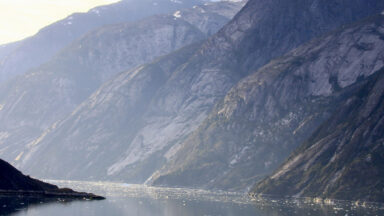
How a melting glacier led to a 500-meter-high tsunami
On August 10, 2025, at precisely 5:26 am local time, the tranquility of Alaska's Tracy Arm fjord was shattered by a cataclysmic event. A colossal rock formation, weighing an estimated 63.5 million cubic meters, broke free from a mountain, plunging into the fjord's deep waters near the South Sawyer Glacier. This dramatic fall generated an initial wave soaring to 100 meters in height, racing across the fjord at speeds surpassing 70 meters per second. When this enormous wave collided with the opposite shore, it surged up the steep cliffs, reaching a staggering height of 481 meters above sea level. According to Aram Fathian, a researcher from the University of Calgary and co-author of a detailed study published in Science, this event marks the second largest tsunami ever recorded globally. "It was a near-miss, largely unnoticed until now," he noted, emphasizing the fortunate timing of the incident, which occurred early in the morning, resulting in no reported injuries or fatalities. However, the potential for future disasters looms large. Tsunamis generated by earthquakes typically result in runup heights of only a few tens of meters upon reaching land. In contrast, landslide tsunamis, such as the one witnessed at Tracy Arm, are often more localized but exhibit significantly greater violence. The sudden displacement of millions of tons of rock into a confined water body like a fjord can lead to exceptionally high waves due to variations in water depth and direct water column displacement. Since 1925, researchers have documented 27 similar events where runup heights exceeded 50 meters, with the most extreme being the 1958 tsunami in Lituya Bay, which reached an astonishing 530 meters. The source of the 2025 tsunami was identified as a steep rock wedge located on the fjord's northern side, with its upper boundary sitting about 1,025 meters above sea level. For centuries, this precarious slope was stabilized by a massive glacier, the South Sawyer. However, like many glaciers in the Stikine Icefield, it has been retreating due to climate change, raising concerns about the stability of the surrounding geological formations.
Sam Altman's World Secures $52.5 Million in Crypto Funding for Online Verification
World, an innovative online verification platform co-founded by Sam Altman of OpenAI fame, has successfully raised $52.5...
TechCrunch | Jul 24, 2026, 16:40
Trump Signals Trade War with EU Over Tech Giants' Fines
In a bold move, President Donald Trump announced on Friday that his administration would initiate a trade investigation ...
CNBC | Jul 24, 2026, 18:15
Infosys Appoints Veteran Leader to Navigate the AI Landscape
Infosys has made a significant move by naming Ashiss Kumar Dash, a long-time company insider, as its next Chief Executiv...
Business Today | Jul 24, 2026, 15:25
Arsenal Seeks AI Engineer to Revolutionize Football Strategy
Arsenal Football Club is on the lookout for a unique addition to its team—not a player, but a research engineer to spear...
Business Today | Jul 24, 2026, 17:20
Midjourney Expands Horizons with Acquisition of Co-Star Astrology App
In a significant move to diversify its offerings, Midjourney, the AI lab renowned for its innovative image and video gen...
TechCrunch | Jul 24, 2026, 15:25