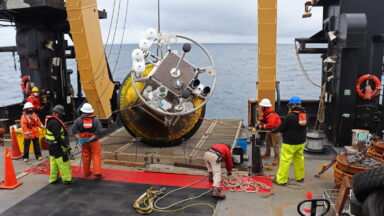
Alaskans will be flying blind after NSF decommissions ocean monitoring network
The imminent shutdown of a crucial deep-ocean monitoring network is causing significant concern among residents of Alaska, the leading state in fish production in the U.S. This network, which has been instrumental in tracking vital ocean metrics such as temperature, salinity, and wave action, is being decommissioned by the National Science Foundation (NSF). Initially announced in May, the Ocean Observatories Initiative, a project worth nearly $368 million, provides real-time data that is essential for scientists, fishery managers, and coastal planners. This information is crucial for making informed decisions regarding fish harvesting, anticipating marine heatwaves, and preparing for potential coastal hazards. Jan Newton, an affiliate professor of biological oceanography at the University of Washington, emphasized the significance of this data, stating, "It helps us see where we’re going and what’s coming at us." The decision to dismantle the observatories has raised alarms within Alaska's fishing community, which supports a robust $5.3 billion commercial seafood industry employing approximately 42,000 individuals, according to a recent report by McKinley Research Group for the Alaska Seafood Marketing Institute. Michelle Stratton, executive director of the Alaska Marine Community Coalition, expressed her alarm over the loss of Ocean Station Papa, a deep-ocean system located in the Gulf of Alaska at depths nearing 14,000 feet. She noted that this system is one of the few that provides real-time insights into ocean changes. Stratton highlighted the critical timing, as Alaska is currently facing challenges such as salmon population declines and repeated marine heatwaves. She stated, "This decision takes away the data we rely on to understand what’s happening and how to manage these fisheries." In response to concerns, NSF spokesperson Cassandra Eichner explained that the decision to withdraw the observatories is part of a broader strategy to adapt to evolving scientific needs and emerging technologies, along with effective lifecycle management of research infrastructure.
The Rise of AI Distillation: A Controversial Technique Sparks Debate in Tech and Government
In recent discussions, a once-obscure topic in artificial intelligence has surged to the forefront of debates among tech...
CNBC | Jul 25, 2026, 12:15
Nvidia Strikes Major Deal with SK Hynix to Secure AI Memory Supply
Nvidia has successfully forged a significant partnership with South Korea's SK Hynix to secure memory supplies essential...
CNBC | Jul 25, 2026, 05:15
Elon Musk Faces Major Setbacks as Tesla and SpaceX See Significant Stock Declines
It has been a challenging week for Elon Musk, as both Tesla and SpaceX experienced substantial stock declines. Tesla sha...
CNBC | Jul 24, 2026, 20:40
Prentis: Ambitious New AI Lab Eyes $100 Million Funding with Innovative Automation Goals
Prentis, a cutting-edge AI research laboratory co-founded by Ritankar Das, Reid Hoffman, and Marc Pincus, is currently i...
TechCrunch | Jul 24, 2026, 22:45
OpenAI's Micro Keypad: A Novelty for Coders or Just a Confounding Gadget?
Last week, OpenAI made its debut in the hardware landscape with the launch of Micro, a stylish keypad designed to integr...
TechCrunch | Jul 25, 2026, 24:40