Think AI will take your job? These workers are still too expensive to replace
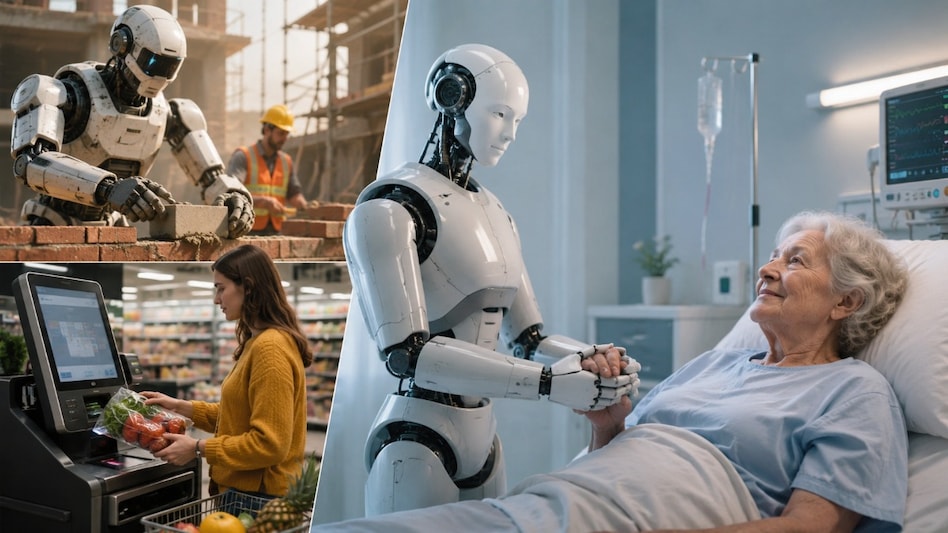
As artificial intelligence reshapes various industries, the replacement of many front-line workers by robots remains a costly endeavor. A recent study conducted by Planera and highlighted by Mint reveals that automating jobs in fields such as nursing, home care, and construction would demand significantly higher investments than the current wages paid to their human counterparts. The analysis examined prevalent occupations across the United States, utilizing government wage statistics alongside actual pricing from automation vendors. The findings indicate that nursing assistants are the most expensive to replace, with an estimated annual cost of around $375,100 for robotic automation, starkly contrasting with the profession's median annual salary of $42,200. This means that automation is nearly nine times pricier than hiring a human worker. Home health and personal care aides follow closely, where the annual cost of automation stands at approximately $282,200—almost eight times the median wage of $35,800. Construction laborers rank third, with the cost of replacing one worker reaching about $285,300 compared to a median salary of $47,100. General maintenance and repair workers are fourth, with annual automation costs around $286,900, while teaching assistants complete the top five at an estimated $194,300—over five times their median wage of $36,700. The study also uncovered various other professions where automation remains prohibitively expensive, with many roles costing at least double the wages of human employees. Interestingly, cashiers were the only significant occupation where automation proved more economical, with self-checkout systems costing around $24,220 annually, less than the median wage of $32,880 for cashiers. A spokesperson from Planera noted a surprising trend: rather than low-paid, low-skill jobs being the first to be automated, it is those in physically demanding, human-centric roles that are the most challenging for machines to replicate. This revelation underscores that the least-paid workers often engage in tasks that require a human touch, which machines currently struggle to perform. The study also hinted at potential disruptions in white-collar professions due to AI advancements, stating that roles in technology, particularly software development, are increasingly under threat as AI coding tools improve. Major tech firms have already begun to reduce their engineering workforce, a clear indication that even seemingly secure positions are not immune to the transformative power of AI.
Unlocking the Secrets of Quantum Gravity: Can AI Help Physics Make a Leap?
The realm of scientific research is undergoing a profound transformation, fueled by the rapid advancements in artificial...
Business Today | Jul 25, 2026, 24:30
The Boring Company Eyes $4 Billion Funding Boost Amid Expanding Tunnel Ventures
Elon Musk's tunneling enterprise, The Boring Company, is reportedly negotiating a substantial funding round of $4 billio...
TechCrunch | Jul 25, 2026, 19:50
The Rise of AI Distillation: A Controversial Technique Sparks Debate in Tech and Government
In recent discussions, a once-obscure topic in artificial intelligence has surged to the forefront of debates among tech...
CNBC | Jul 25, 2026, 12:15
Warner Bros. Takes Legal Action Against Amazon Over Executive Poaching Allegations
Warner Bros. Discovery has initiated legal proceedings against Amazon, accusing the tech giant of unlawful interference ...
TechCrunch | Jul 25, 2026, 21:25
The Shift in Human Cognition: Embracing AI as a Collaborative Tool
As technology continues to evolve, a notable shift is occurring in the relationship between humans and artificial intell...
Business Insider | Jul 25, 2026, 09:50