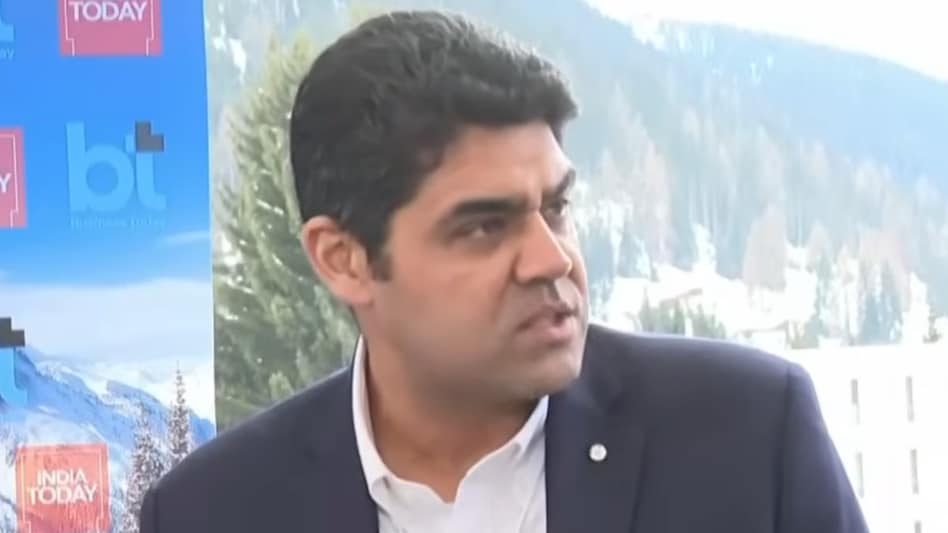
Davos 2026: 'AI-enabled vulnerabilities represent the greatest cyber risk today,' says WEF’s Akshay Joshi
Artificial intelligence (AI) is swiftly becoming a pivotal concern in the realm of cybersecurity, fundamentally altering the dynamics of global threats. According to Akshay Joshi, the Head of the Centre for Cybersecurity at the World Economic Forum, AI-driven vulnerabilities are currently the most significant cyber threat. Speaking with Business Today at the World Economic Forum in Davos, he noted that the evolution of cybersecurity risks often aligns with major technological advancements, but AI's rapid adoption sets it apart. "Cybersecurity is a perennial challenge. With each wave of new technology, we begin to recognize the accompanying risks and vulnerabilities. What makes AI particularly noteworthy is the speed of its integration into various sectors," Joshi remarked. Insights from the Forum’s Global Cybersecurity Outlook reveal that companies are racing to adapt. When surveyed last year, only 37% of organizations reported testing AI tools for security purposes prior to their deployment. This year, however, that figure has climbed to 64%. "This is a positive trend," Joshi emphasized. Meanwhile, anxiety regarding AI-induced threats has grown. "Eighty-seven percent of those surveyed believe that AI-driven vulnerabilities pose the greatest cyber risk today," he stated, characterizing AI as a dual-faceted entity that can empower both attackers and defenders. The Centre for Cybersecurity is investigating how AI can enhance cyber defense mechanisms, including anomaly detection and insider threat identification. "AI shows great promise in these areas, especially given the global shortage of cybersecurity experts," he explained, highlighting the need for AI to complement human skills amid an estimated shortfall of five million cybersecurity professionals worldwide. Adding to the complexity is the intertwining of geopolitics and cybersecurity. Joshi pointed out that geopolitical tensions increasingly complicate cyber strategies, putting critical infrastructure and private organizations in precarious positions. Regarding India's cybersecurity readiness, he offered a nuanced perspective. "India is somewhere in the middle, reflecting about 50% confidence in its cybersecurity capabilities. While there is optimism, there is also some skepticism," he noted. Ultimately, Joshi emphasized that cybersecurity transcends technical boundaries, affecting individuals, businesses, and governments alike.
Apple Raises Subscription Prices for Services in India
In a significant move, Apple has announced an increase in the prices of its subscription services in India, following re...
Business Today | Jul 20, 2026, 06:00
India's Groundbreaking Leap in Precision Timing with White Rabbit Technology
In the realm of modern digital infrastructure, time stands as an unseen yet crucial component. Every mobile call, financ...
Business Today | Jul 19, 2026, 10:50
Accenture Unveils Innovative Salary Model to Enhance Employee Compensation
Accenture has introduced a fresh approach to salary increases, dividing approved raises equally between base salary and ...
Business Today | Jul 19, 2026, 13:30
Silicon Valley on Edge as China's Kimi K3 AI Model Makes Waves
In the tech world, every new release from China seems to spark concern in Silicon Valley, and the introduction of the Ki...
Business Insider | Jul 20, 2026, 04:55Emerging Legal Tech Startups Reshaping the Industry Landscape for 2026
The legal technology sector is experiencing a remarkable transformation, largely driven by advancements in artificial in...
Business Insider | Jul 20, 2026, 06:20