Indian children seek AI advice over their own parents: Vivo Switch Off Report 2025
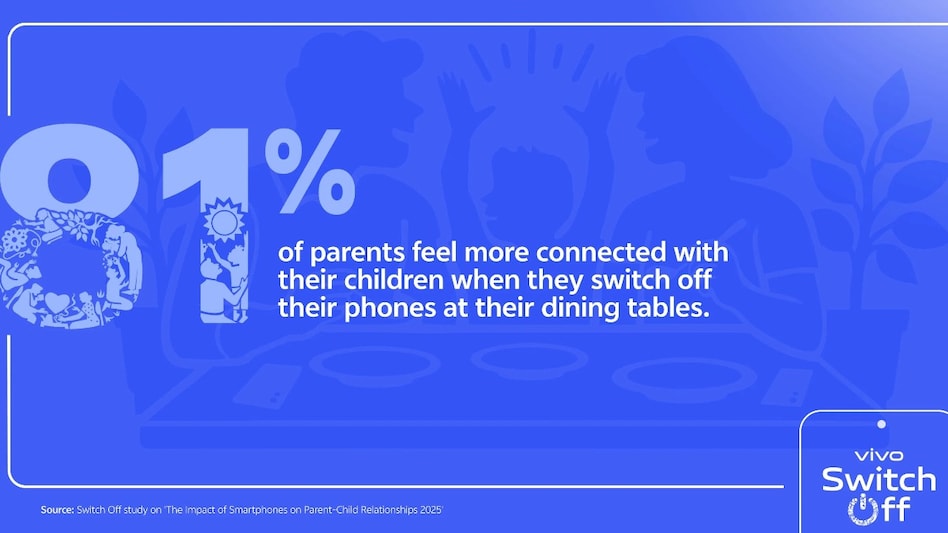
A recent study reveals that Indian families are increasingly striving to create boundaries around smartphone usage, particularly during dinner, which has been identified as a vital time for family connection. The seventh annual Vivo Switch Off Study, released today, indicates that a staggering 72% of children spend most of their quality time with their parents at the dinner table. Notably, 91% of these children feel that conversations become more meaningful when smartphones are set aside, underscoring the importance of dinner as a key moment for parental engagement. However, the study highlights a concerning trend: 72% of parents and 30% of children believe that parental phone checking during meals significantly hampers dialogue. Furthermore, this year’s findings shine a light on how children are increasingly relying on artificial intelligence (AI) tools. A significant 67% of children reported turning to AI for support, citing their parents' busy schedules as a primary reason for reduced communication. Among those surveyed, 54% of children aged 10 to 16 actively use AI for schoolwork and personal development, with 33% considering AI as a sort of companion. The data also reveals a stark contrast in smartphone usage between parents and children. Parents average 4.4 hours on their devices each day, while children use theirs for about 3.5 hours. This pattern indicates that parents are more engaged with their phones during family activities, such as movie nights (70% of parents versus 31% of children) and family gatherings (64% versus 59%). Geetaj Channana, Head of Corporate Strategy at Vivo India, commented on the findings, stating that the study illustrates families' desire to create balance by disconnecting during crucial moments to enhance their presence in daily life. The report concludes with encouraging news: families are implementing effective strategies to manage screen time, with 54% of parents limiting usage, 51% blocking social media during certain hours, and 50% of children turning off non-essential notifications. These actions have resulted in 59% of parents and 47% of children feeling more in control of their digital habits.
Nvidia Strikes Major Deal with SK Hynix to Secure AI Memory Supply
Nvidia has successfully forged a significant partnership with South Korea's SK Hynix to secure memory supplies essential...
CNBC | Jul 25, 2026, 05:15
Unleashing the Power of AI: The 5 Smartphones Redefining Mobile Photography
Artificial Intelligence (AI) is transforming our daily experiences, permeating various aspects of technology, including ...
Business Today | Jul 26, 2026, 07:05
Kalshi Challenges Netflix Over Controversial Documentary Trailer
Kalshi, the prediction market platform, has taken significant legal steps against Netflix, sending a cease-and-desist le...
TechCrunch | Jul 25, 2026, 17:10
Market Turbulence: Four Key Factors Impacting Stocks This Week
This past week has been challenging for the stock market, driven by several significant forces that have created turbule...
CNBC | Jul 25, 2026, 20:05
The Boring Company Eyes $4 Billion Funding Boost Amid Expanding Tunnel Ventures
Elon Musk's tunneling enterprise, The Boring Company, is reportedly negotiating a substantial funding round of $4 billio...
TechCrunch | Jul 25, 2026, 19:50