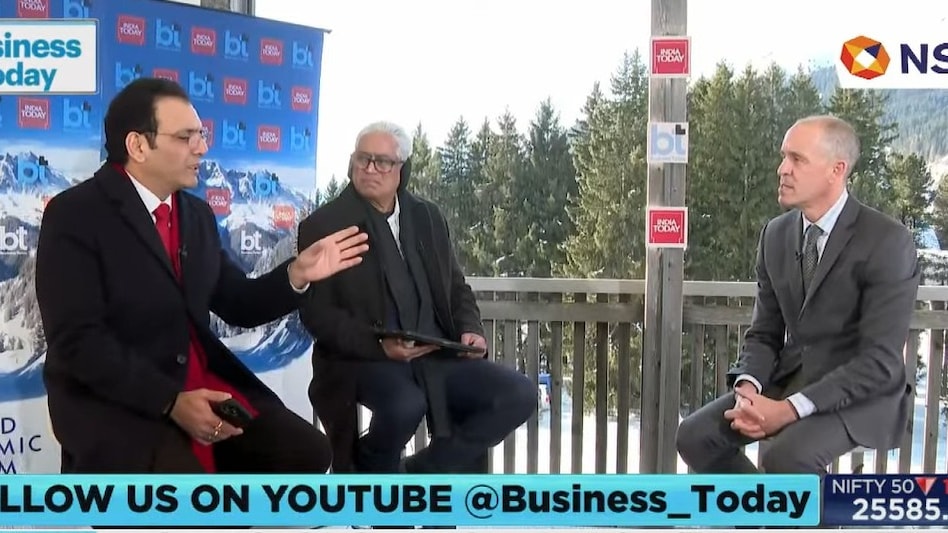
Davos 2026: AI is not a bubble, it’s the next industrial revolution, says OpenAI’s Christopher Lehane
At the World Economic Forum (WEF) in Davos 2026, discussions around artificial intelligence (AI) are intensifying, despite a growing chorus of skeptics questioning the sustainability of its hype. However, Christopher Lehane, Chief Global Affairs Officer at OpenAI, firmly believes the argument has been resolved. In an interview with Business Today on the opening day of the forum, Lehane emphasized that AI should not be viewed as a fleeting phenomenon but rather as a revolutionary technology akin to the combustion engine, electricity, and semiconductors—each of which fundamentally transformed global productivity and economic landscapes. "AI is genuinely transformational," Lehane asserted, highlighting new data that suggests individuals and businesses leveraging AI effectively can achieve a staggering sevenfold increase in economic productivity. This implies that one individual can generate seven times more economic output, and organizations can extract significantly greater results from their existing workforce. He noted that the scale of AI adoption already undermines the bubble theory. Currently, over 850 million people regularly utilize AI tools, while more than four million developers are engaged in AI projects, and over a million businesses are incorporating this technology into their operations. "These figures are only set to rise," he predicted. "Tomorrow’s numbers will surpass today’s, and the day after that will see even higher figures. The real issue isn’t whether AI is a bubble; it’s about whether you’re integrating AI into your systems or risk being left behind." Lehane characterized AI as a productivity-enhancing technology, drawing parallels to electricity. "We provide the power. It’s up to people to create the stoves, cars, airplanes, and entirely new sectors on top of it," he explained. He cautioned about what OpenAI identifies as the “capability gap,” which signifies the widening chasm between those who adopt AI effectively and those who do not. Entities lagging in AI adoption face the potential risk of unprecedented economic disadvantage. According to Lehane, 2026 will be a crucial year for AI integration, especially in sectors like healthcare, education, enterprise, and government, where AI is increasingly becoming embedded in national infrastructures. "Misinterpreting AI as a bubble is a strategic error," he warned. "This is not social media; this is not cryptocurrency. This is a foundational technology for the Intelligence Age." He concluded that the nations and organizations that act swiftly will shape the future of global economic leadership, whereas those that hesitate may find themselves struggling to catch up.
The Aluminum Foil Trend: A DIY Shield Against Wireless Identity Theft
Have you noticed an unusual trend where people are wrapping their wallets in aluminum foil? This peculiar practice has e...
Business Today | Jul 25, 2026, 02:45
Finland Unveils World's Largest Sand Battery to Tackle Renewable Energy Challenges
In a groundbreaking move to address the critical issue of renewable energy intermittency, a small town in southern Finla...
CNBC | Jul 25, 2026, 05:35
Market Turbulence: Four Key Factors Impacting Stocks This Week
This past week has been challenging for the stock market, driven by several significant forces that have created turbule...
CNBC | Jul 25, 2026, 20:05
Vision Breakthrough: US Startup Launches Groundbreaking Retina Chip in Europe
Science Corp is poised to introduce a revolutionary retina chip in Europe, designed to restore partial vision for indivi...
Business Today | Jul 25, 2026, 01:00
Crisis Averted: Power Line Failure Highlights Urgent Need for Data Center Resilience
A power line failure near Washington, DC, recently showcased a significant challenge faced by the electrical grid due to...
TechCrunch | Jul 25, 2026, 13:50